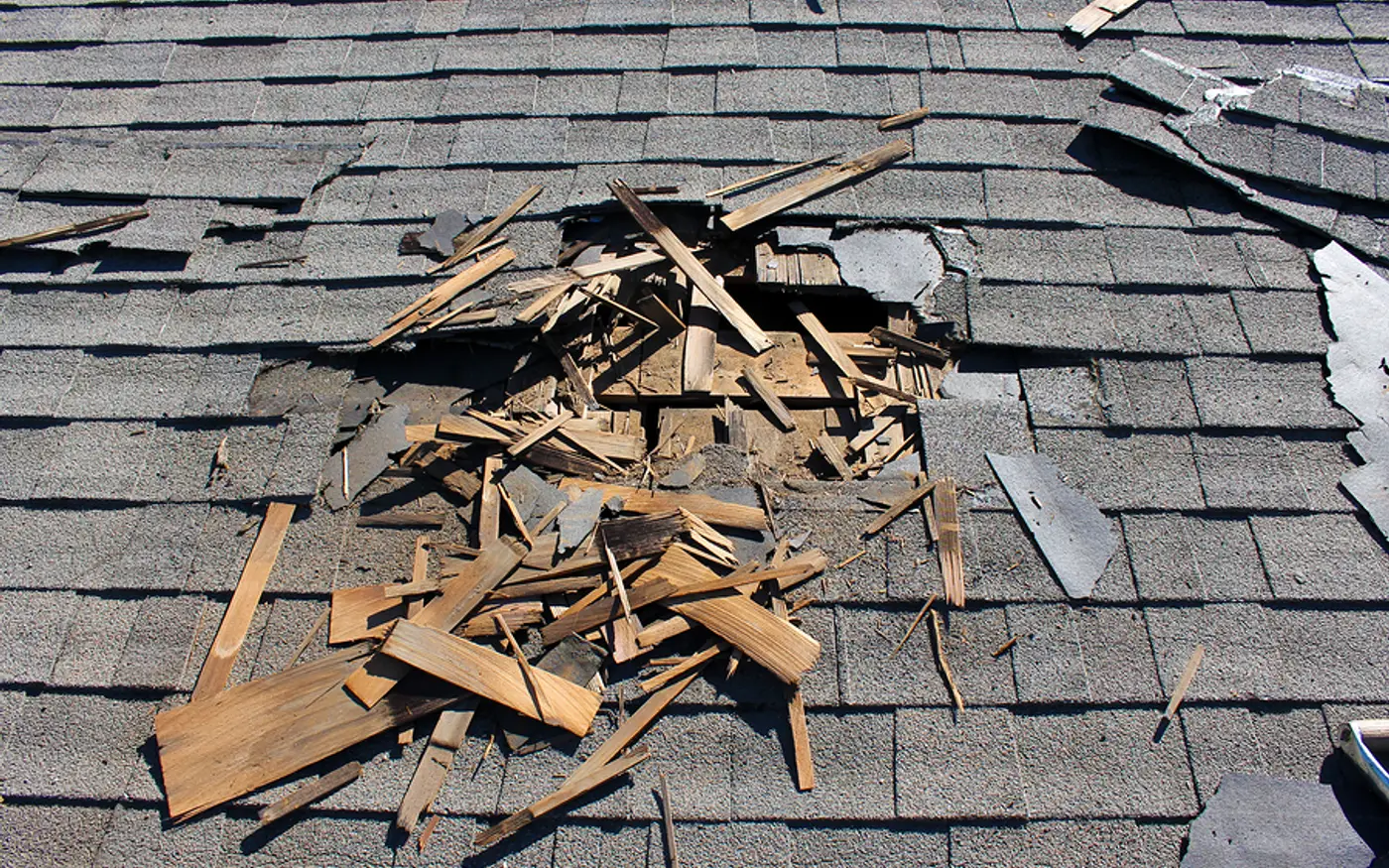
If hail or high wind has hit your roof in St. Charles, St. Charles Roofing Designs will look at the roof, photograph every damaged area with dated photos you can share with your insurer, and tell you plainly whether a repair will do or the roof needs replacing. Quotes are free and written. Call (636) 242-5111, 8am to 8pm, seven days a week.
Why storm damage is a St. Charles problem, not a someday problem
Hail is part of living here. According to the National Weather Service, the St. Louis area sees thunderstorms on 40 to 50 days a year, and enough of them carry hail that Missouri ranked second in the nation for State Farm hail claims in 2025, behind only Texas.
St. Charles County has taken its share. On March 14, 2024, the National Weather Service documented supercells over the county that dropped hail of 3 to 3.75 inches, with 3-inch stones photographed in O'Fallon. Ten weeks later, on May 26, 2024, the largest hail reported was 2.75 inches near Saint Charles, with 2 to 2.5-inch hail elsewhere in the county and spotter-estimated 70 mph winds in Saint Peters. That November, a confirmed EF-0 tornado cut a six-mile track through northwestern St. Charles County and caused minor roof damage to homes. Our St. Charles County hail history lays out these events and older ones, including the widespread golf-ball to baseball-size hail of April 28, 2012.
Most hail damage is invisible from the driveway, and that is exactly why it turns into a leak a year later.
What storm and hail damage repair covers
Storm work is two jobs in one. The first is finding and documenting the damage accurately. The second is fixing it correctly, which can mean replacing a handful of shingles, rebuilding flashing around a chimney, or replacing the whole roof. We handle residential roofs first and foremost, and we also work on commercial roofs after storms.
Hail damage
Hailstones strike shingles and knock off the protective granules. On asphalt shingles, the result is a bruise: a dark, roughly round mark where the asphalt is exposed, sometimes with a fractured fiberglass mat underneath that feels soft when pressed. Exposed asphalt breaks down in sunlight, and a cracked mat lets water through. Hail also dents metal vents, flashing, gutters and downspouts, and it can crack older, brittle shingles outright.
Wind damage
Wind gets under shingle edges, breaks the adhesive seal strips, and creases or lifts tabs. Creased shingles may lie flat again and look fine, but the seal is broken and the next storm can peel them off. Wind also loosens ridge caps, rake-edge shingles and flashing, and it throws branches and debris onto the roof.
Water that has already gotten in
If a storm opened the roof, water can soak the decking, insulation and drywall. We look in the attic where we can, because wet or delaminated decking has to be replaced before new shingles go down. Under the residential code, a roof that is water-soaked or deteriorated cannot simply be covered over.
Signs your roof took storm damage
Start on the ground. You don't need a ladder for most of these, and you shouldn't be on a wet or damaged roof.
- Dents or dings in gutters, downspouts, window screens, the air-conditioner condenser fins, or metal roof vents.
- Piles of dark granules at downspout outlets or in the gutters, more than the usual light scattering.
- Shingles lying in the yard, or bare spots, lifted tabs and creases visible from the street.
- Loose or bent flashing at chimneys, walls or skylights.
- New water stains on ceilings, especially near exterior walls, chimneys and bathroom vents.
- Damp insulation, daylight through the decking, or a musty smell in the attic.
- Neighbors on your street with crews on their roofs. Hail falls in swaths, and if the house next door was hit, yours may have been too.
How we handle a storm-damage roof
Our process is the same one we use on every job, with extra care on documentation because your insurer may want to see it.
- We look before we quote. We get on the roof when it is safe, check every slope, and look in the attic where we can. A roof inspection after a storm should cover the shingles, ridge, flashing, vents, gutters and decking, not just the obvious spots.
- We photograph what we find. You get dated photos of the damage, slope by slope, with the soft metals and collateral damage included. You can share them with your insurer and any adjuster they send.
- We tell you what it actually needs. If the damage is limited and the roof is otherwise sound, a roof repair may be the honest answer. If bruising covers the roof or the shingles are near the end of their life, we'll explain why a full roof replacement makes more sense.
- You get a free written quote. It spells out the scope: tear-off, decking, underlayment, flashing, ventilation and the shingle or metal you choose.
- We build to the code and the manufacturer's instructions. That means drip edge at eaves and rakes, correct valley and wall flashing, ice and water protection where it matters, and the nailing pattern the shingle maker specifies.
- We clean up and walk you through it. Old shingles, nails and debris leave with us, and we go over the finished roof with you.

Insurance, deductibles and your rights under Missouri law
We don't handle insurance claims, and no roofer should promise you a claim outcome. What we do is document what we find so you can make an informed decision. Here is what's worth knowing before you file.
Your deductible may be a percentage
Many policies now use a wind and hail deductible of 1% to 2% of the dwelling coverage amount (Coverage A) rather than a flat dollar figure. The Missouri Department of Commerce and Insurance gives the example of a 2% deductible on a $100,000 home: $2,000 out of pocket. Check your declarations page so you know the number before you decide whether to file.
Actual cash value versus replacement cost
Some policies pay replacement cost value (RCV), which covers the cost of a new roof minus your deductible. Others pay actual cash value (ACV), which subtracts depreciation for the roof's age. The Department of Commerce and Insurance warns that on an ACV basis, a 20-year-old roof may be paid at as little as 20% of the cost to replace it. The department's Raising the Roof comparison tool shows how the largest Missouri insurers treat roof coverage.
RSMo 407.725 protects you
Missouri's roofing law applies to contractors repairing or replacing roofs on homes and commercial buildings. It bars any roofer from advertising or promising to pay or rebate your deductible. It gives you the right to cancel a contract funded by your property policy before midnight of the fifth business day after your insurer tells you in writing that all or part of the claim isn't covered. The contractor has to give you that cancellation right in bold type with a detachable cancellation form before you sign, and must refund payments within 10 days of a cancellation. Our guide to Missouri hail damage claims and your rights walks through each part.
Be cautious with anyone who offers to cover your deductible, pressures you to sign on the spot, asks you to sign over your insurance check, or can't give you a local address. Our office is at 498 S 5th St. in St. Charles, and you can call us any day from 8am to 8pm.
Materials and code details that matter on a storm rebuild
A roof that gets replaced after hail should come back better than it left, and in St. Charles County that starts with the local code. The county's residential code and the City of St. Charles both classify weathering as "Severe" and set a 107 mph design wind speed; St. Peters uses 115 mph. Shingles need to carry a wind rating that fits.
- Drip edge at eaves and rakes. St. Charles County's amendments require it at both, lapped 2 inches and fastened no more than 12 inches apart.
- Ice and water protection. The local code tables say ice barrier is not required here, but we still recommend self-adhered membrane in valleys, around chimneys and penetrations, and on low-slope sections, where storm-driven water does the most damage.
- The two-layer limit. If your roof already has two layers, the code doesn't allow a third. A storm replacement on a layered roof means a full tear-off.
- Impact-rated products. Shingles tested to UL 2218 Class 4 resist hail better than standard shingles, and some insurers offer premium discounts for them. Our comparison of Class 4 and Class 3 shingles explains the difference, and stone-coated steel shingles are another hail-resistant option. DECRA's published warranty, for example, covers hail up to 2.5 inches. Still, no roof is hail-proof.
What affects the cost of storm repair
We don't quote prices sight unseen, because storm jobs vary more than almost any other roofing work. The main factors are:
- How much of the roof is damaged: a few shingles, one slope, or every slope.
- Whether the decking got wet and has to be replaced.
- How many layers have to be torn off.
- Roof size, pitch and complexity, including dormers, valleys and chimneys.
- Whether the existing shingle can still be matched for a repair.
- The replacement material, from architectural shingles to impact-rated or metal products.
Whether your insurer pays, and how much, depends on your policy, your deductible and the adjuster's findings, not on us. You'll get a free written quote that shows exactly what we'd do.
Storm damage across St. Charles County
Hail falls in swaths, and different parts of the county get hit in different storms. In the subdivisions of St. Peters and Harvester, many roofs date from the 1980s and '90s or are on their second round of shingles, and older shingles bruise and crack more easily. In Cottleville, many homes are recent builds whose roofs are young but often builder-grade. The open, more exposed country around Orchard Farm and north St. Charles County was where the November 2024 EF-0 touched down.
In the city's historic districts, such as Frenchtown, storm repairs that change the roof's material or appearance can require a Certificate of Appropriateness from the Landmarks Board, even after a storm. Our historic home roofing page explains how that review works. And if your home sits in a mapped floodplain, St. Charles County requires a floodplain development permit even for reroofing.
Next step: get the roof looked at
If a storm has rolled through and you're not sure what it did to your roof, call (636) 242-5111 or send a request through the form on this page. We'll set up a time to look at the roof, photograph what we find, and give you a free written quote with a straight answer on repair versus replacement.
Frequently Asked Questions
How do I know if hail damaged my roof?
From the ground, look for dented gutters, downspouts, window screens and metal vents, and for granules piling up at downspout outlets. On the roof, hail bruises show as dark, round spots where granules were knocked off, sometimes with a soft or cracked mat underneath. Wind damage shows as creased, lifted or missing shingles. The surest way to know is to have someone walk the roof and photograph each slope.
Should I call my insurance company or a roofer first?
Either order can work, but many homeowners find it helpful to know what is actually on the roof before opening a claim. We look at the roof, photograph what we find and tell you whether we see storm damage. You can share those dated photos with your insurer. Remember that many Missouri policies use a percentage wind and hail deductible, so check your declarations page before deciding.
Can a roofer pay my insurance deductible in Missouri?
No. Missouri law, RSMo 407.725, bars roofing contractors from advertising or promising to pay or rebate any part of a policyholder's deductible, including through discounts, credits, gifts or allowances offered as an inducement. If a contractor offers to cover your deductible, that is a red flag. The deductible is your share of the loss under your policy, and it is not something a roofer can legally absorb.
Can I cancel a roofing contract if my claim is denied?
Under RSMo 407.725, if a roofing contract is to be paid from a property and casualty policy, you may cancel it before midnight of the fifth business day after you receive written notice from your insurer that all or part of the claim is not covered. The contractor must give you a cancellation notice before you sign and must refund payments within 10 days, except for emergency work you approved in writing.
Can a hail-damaged roof be repaired instead of replaced?
Sometimes. If hail or wind affected one slope or a small area, and the rest of the roof is in good condition, replacing the damaged shingles and flashing can be a sound repair. If bruising is spread across every slope, if the shingles are old and brittle, or if matching the existing shingle is not possible, replacement usually makes more sense. We tell you which one we think fits after looking at the roof.
Are Class 4 impact-rated shingles hail-proof?
No. A UL 2218 Class 4 rating means a sample did not crack when struck by a 2-inch steel ball dropped from 20 feet. That is a meaningful step up, but the Insurance Institute for Business and Home Safety tested impact-resistant shingle products in 2025 and rated none of them Excellent. Class 4 shingles resist hail better, and some insurers offer discounts for them, but very large hail can still damage them.
How soon after a storm should I have my roof looked at?
As soon as is practical, and especially if you see water stains, dripping or missing shingles. Hidden hail bruising can let water in months later, and most policies require you to report damage within a set period and take reasonable steps to prevent further damage. Check your policy for its reporting deadline, then call us at (636) 242-5111, any day from 8am to 8pm.