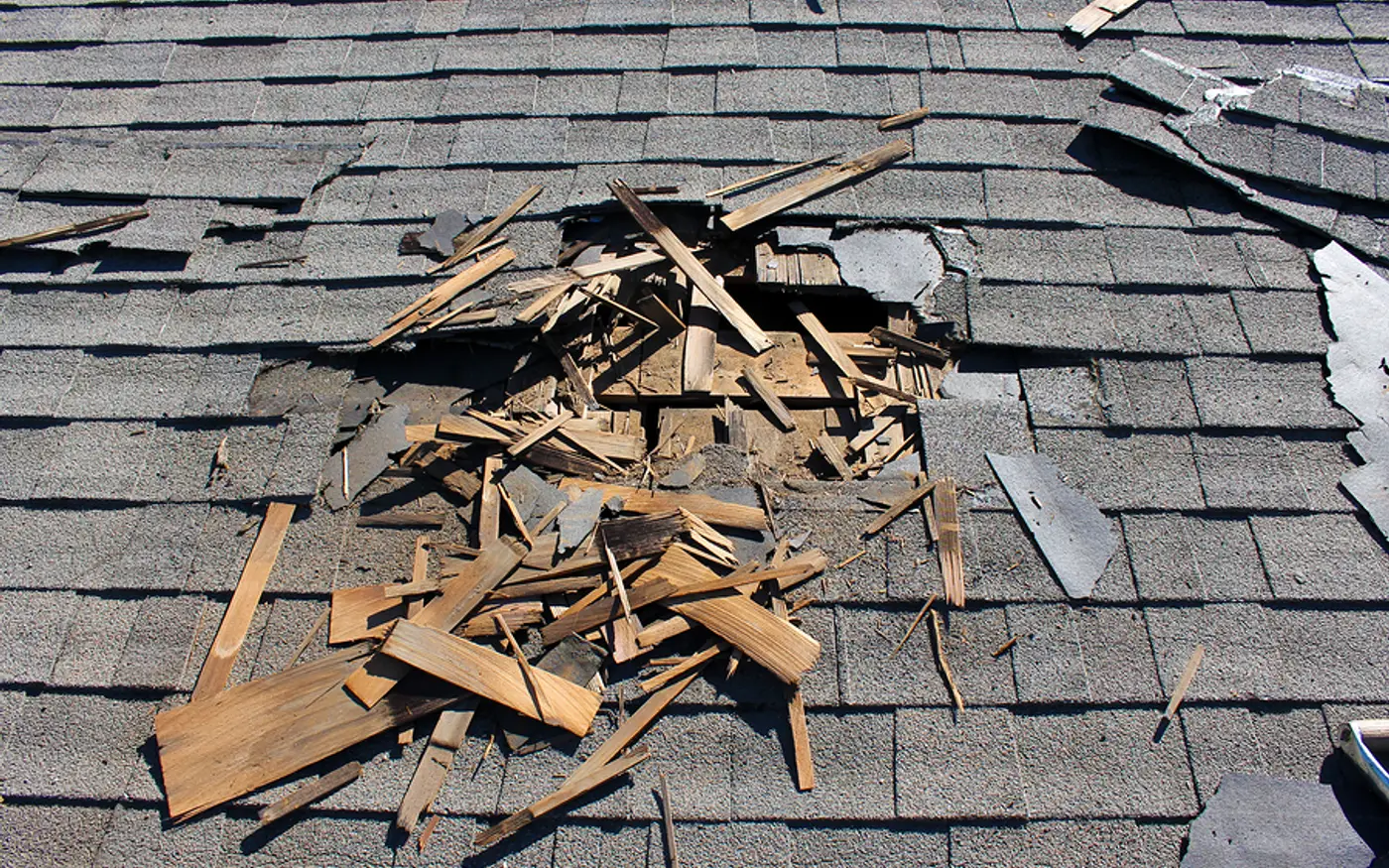
St. Charles County gets serious hail. The National Weather Service documented hail of 3 to 3.75 inches over the county on March 14, 2024, hail up to 2.75 inches near St. Charles on May 26, 2024, and golf-ball to baseball hail on April 28, 2012. St. Charles Roofing Designs explains how to check whether a storm hit your street and what to do next.
Why St. Charles County roofs take a beating
Missouri ranks near the top of the country for hail losses. According to State Farm, Missouri was second in the nation for State Farm hail claims in 2025, behind only Texas, after ranking third in 2024 with roughly $580 million in claims. The National Weather Service St. Louis office reports that the St. Louis area sees thunderstorms on 40 to 50 days a year, and spring is the peak season for the supercells that produce large hail.
That matters for every roof in the county, from 1970s ranches in St. Peters to new construction in Cottleville and older homes in the river towns. Hail damage is not always obvious from the ground, and a roof that looks fine in the driveway can have bruised or cracked shingles that start leaking a season or two later.
Documented hail and wind events in St. Charles County
The table below lists only events documented by the National Weather Service. Third-party hail-mapping sites publish many more dates and sizes, but their estimates are modeled from radar and are not official records, so we have left them out.
| Date | What the NWS documented | Where |
|---|---|---|
| April 28, 2012 | Widespread golf-ball to baseball-size hail | Across St. Charles County |
| March 14, 2024 | Supercells produced hail of 3 to 3.75 inches; 3-inch hail photographed in O'Fallon; about 300 storm reports that day | Over St. Charles County |
| May 26, 2024 | Largest hail 2.75 inches; 2.0 to 2.5 inches elsewhere in the county; spotter-estimated 70 mph winds | Near St. Charles; winds in St. Peters |
| November 4–5, 2024 | EF-0 tornado on a 6-mile track; pole barn partly destroyed; minor roof damage to homes | Northwestern St. Charles County |
April 28, 2012
The NWS St. Louis office's event summary describes widespread hail from golf-ball to baseball size across St. Charles County. Golf-ball hail is 1.75 inches and baseball hail is about 2.75 inches. Hail that size damages shingle roofs, gutters, siding and cars, and many county roofs replaced after that storm are now well into their second decade.
March 14, 2024
This was the most severe recent hail event in the county. According to the National Weather Service's March 14, 2024 event summary, supercell thunderstorms produced hail of 3 to 3.75 inches over St. Charles County, and 3-inch hail was photographed in O'Fallon. The office logged around 300 storm reports that day. Hail of 3 inches and up can crack shingles outright, puncture skylights and dent metal roofing.
May 26, 2024
Ten weeks later, another round hit. The NWS summary for May 26, 2024 lists the largest hail at 2.75 inches near Saint Charles, with 2.0 to 2.5-inch hail elsewhere in the county and spotter-estimated 70 mph winds in Saint Peters. Many homes that came through March were hit again, which complicates insurance claims: adjusters may ask which storm caused which damage.
November 4–5, 2024
Not every damaging storm is a spring hail event. The NWS confirmed an EF-0 tornado with a 6-mile track in northwestern St. Charles County. It partly destroyed a pole barn and caused minor roof damage to homes. EF-0 winds tend to peel shingles, lift edges and tear off ridge caps rather than destroy roofs, but that damage still lets water in.
The EF3 tornado of May 16, 2025, with 152 mph peak winds on a 12.29-mile path, led to roughly 10,000 claims. It struck the City of St. Louis, not St. Charles County, but it is a reminder of how much damage one storm can do in this region.
If a storm is in the record for your area, write down the date. Your insurer will ask for it.
How to check whether hail hit your street
You don't have to guess. Official storm data is public and free, and it is the same information adjusters and roofers reference.
- Start with the NWS St. Louis office. After significant storms, the office publishes event summaries at weather.gov/lsx with maps, hail sizes and photos. Search for the storm date.
- Check the Storm Prediction Center's storm reports. The SPC storm reports page lists hail, wind and tornado reports by date, with size, time and the nearest town. Reports come from trained spotters, the public and emergency managers.
- Look for older events in NOAA's Storm Events Database. The National Centers for Environmental Information keeps a searchable archive by county and date, useful when you're buying a house or trying to date old damage.
- Check the soft metals on your own property. Dents on gutters, downspouts, mailboxes, window screens, AC condenser fins and car hoods show where hail fell and roughly how big it was.
- Note the date and take photos. Dated photos of what you see from the ground, plus the storm date from the NWS or SPC, give you a clear record before you call anyone.
Keep in mind that a storm report is a point on a map. Hail falls in narrow swaths, so one subdivision can take golf-ball hail while the next one over gets pea-size. A report near you is a reason to look, not proof your roof was damaged.
What hail damage looks like on a roof
On asphalt shingles, hail usually leaves random dark spots where the granules have been knocked loose, soft bruises that feel spongy when pressed, and on larger hail, cracks or broken corners. Granules collecting in gutters and at downspout outlets are another clue. On metal roofs, look for dents in the panels and damaged trim. Stone-coated steel can lose chips of its stone coating where it was struck.

Wind damage is different: creased or lifted shingles, missing tabs, exposed nail lines and torn ridge caps, usually along edges and ridges. After a storm with both hail and wind, like May 26, 2024, a roof can show both.
What to do after a storm
- Stay off the roof. Wet, damaged roofs are slippery and may have soft spots. Look from the ground and from the attic for water stains or daylight.
- Stop active leaks. If water is coming in, a temporary tarp or patch limits damage. Keep receipts.
- Get a roof inspection. A roof inspection tells you whether damage is real and how widespread it is. We photograph what we find so you have dated photos you can share with your insurer.
- Read your policy. Many Missouri homeowners policies now use a wind and hail deductible of 1% or 2% of the home's Coverage A value. On a $100,000 home, a 2% deductible is $2,000, according to the Missouri Department of Commerce and Insurance. Some older roofs are paid at actual cash value. Check your declarations page.
- Know your rights before signing. Under RSMo 407.725, no roofer may offer to pay or rebate your deductible, and you can cancel a claim-funded roofing contract within five business days after your insurer tells you in writing that the claim isn't covered. Our guide to Missouri hail damage roof claims and your rights covers the details.
- Repair or replace. Limited damage can be handled with roof repair. Widespread hail bruising usually means storm and hail damage roof repair or a full roof replacement.
Building a roof that stands up to the next storm
If you are replacing a roof anyway, consider impact resistance. Shingles rated Class 4 under UL 2218 survived a 2-inch steel ball dropped from 20 feet without cracking, and some insurers offer premium discounts for Class 3 or Class 4 roofs. But the Insurance Institute for Business & Home Safety tested 24 impact-resistant shingle products in 2025 and rated most of them Good and none Excellent, so Class 4 isn't hail-proof. Our comparison of Class 4 vs Class 3 shingles walks through the tradeoffs.
Metal and stone-coated steel shingles are the other common hail upgrade. DECRA's published warranty, for example, covers hail up to 2.5 inches. That is a manufacturer's warranty with its own terms, and hail larger than that, like the 3 to 3.75-inch stones of March 2024, falls outside it.
Storm risk across the county
Hail doesn't respect town lines, but exposure varies. Homeowners in St. Peters saw spotter-estimated 70 mph winds on May 26, 2024. The November 2024 EF-0 tracked across rural northwestern St. Charles County, a reminder for farm and acreage owners in Orchard Farm and north St. Charles County, and river towns like Portage des Sioux face open, unbroken wind across the bottoms. Wherever you live, if a documented storm passed through, it is worth having the roof checked. Call St. Charles Roofing Designs at (636) 242-5111, 8am to 8pm, seven days a week, for a free written quote.
Frequently Asked Questions
What was the biggest hail recorded in St. Charles County?
Among recent events documented by the National Weather Service St. Louis office, the largest was March 14, 2024, when supercells produced hail of 3 to 3.75 inches over St. Charles County, with 3-inch hail photographed in O'Fallon. On April 28, 2012, the NWS also documented golf-ball to baseball-size hail across the county. Older records exist in NOAA's Storm Events Database.
How can I tell if hail hit my house?
Start with the record: check the National Weather Service St. Louis event page for the date and the Storm Prediction Center's storm reports, which list hail size and location. Then look on the ground for dented gutters, downspouts, mailboxes, window screens and AC fins. Those soft metals show hail first. Leave the roof to a professional rather than climbing up yourself.
What size hail damages a shingle roof?
It depends on the shingle's age and condition, wind, and how hard the hail falls, so there is no single cutoff. Hail around 1 inch can bruise older or brittle shingles, and hail 1.75 inches (golf-ball size) and larger often damages roofs of any age. Damage shows as dark spots where granules are knocked loose, soft bruises, and cracked shingles.
How long do I have to file a hail claim in Missouri?
The deadline is set by your policy, not a single state rule, so read the conditions section of your homeowners policy or call your agent. Many policies require prompt notice of a loss. Waiting also makes it harder to tie damage to a specific storm, which is why noting the storm date and taking dated photos right away helps.
Are Class 4 shingles hail-proof?
No. A Class 4 rating under UL 2218 means a sample survived a 2-inch steel ball dropped from 20 feet without cracking. That is a meaningful step up, but in 2025 testing of 24 impact-resistant shingle products, the Insurance Institute for Business & Home Safety rated most of them Good and none Excellent. Class 4 shingles resist hail better; they don't make a roof immune.