
St. Charles Roofing Designs repairs and replaces roofs on Historic Main Street, from the low-slope roofs behind downtown's brick parapets to the steep gables of 1800s homes along South Main. Work here is shaped by two local preservation districts and by buildings that are mostly mixed-use. Our office on South Fifth Street is a few blocks up the hill, and quotes are free and written. Call (636) 242-5111.
Main Street and the two districts that cover it
Historic Main Street is the oldest part of St. Charles and the reason many visitors come at all. It holds the First Missouri State Capitol and the Lewis and Clark embarkation point along the Missouri River, and its brick storefronts date largely from the 1800s. The whole stretch sits inside the St. Charles Historic District, listed on the National Register in 1970 and enlarged in 1987, 1991 and 1996, with Greek Revival, Italianate and Late Victorian buildings.
For roofing, the more important layer is local. Main Street is split between two of the city's six local preservation districts:
| District | Rough boundaries | Size |
|---|---|---|
| Historic Downtown District | Third Street (west) to the Missouri River (east), Clark Street (north) to Madison Street (south) | About 15 blocks, 85 properties |
| South Main Preservation District | Alley between Second Street and South Main (west) to the river (east), Madison Street (north) to roughly Boonslick Road (south) | About 9 blocks, 105 properties; period of significance 1790 to 1920 |
North of Clark Street, the Frenchtown district picks up where the Historic Downtown District ends.
Two kinds of roofs on one street
Commercial blocks: flat roofs behind parapets
Most downtown commercial buildings have flat or low-slope roofs that you can't see from the sidewalk. A brick parapet rises above the roof line on the street side and often on the party walls between buildings. Historically those roofs were tarred or covered with roll roofing. Today they're typically re-covered with a modern low-slope membrane, which we cover in detail on our commercial roofing page.
The membrane is only one part of the system. These roofs drain through internal drains or through scuppers cut in the parapet, and every parapet needs a sound coping cap and flashing where the membrane turns up the wall. Shared party walls between neighboring buildings add another wrinkle: the flashing on your side may depend on the condition of a wall you share.
Residences: steep gables, slate and tile
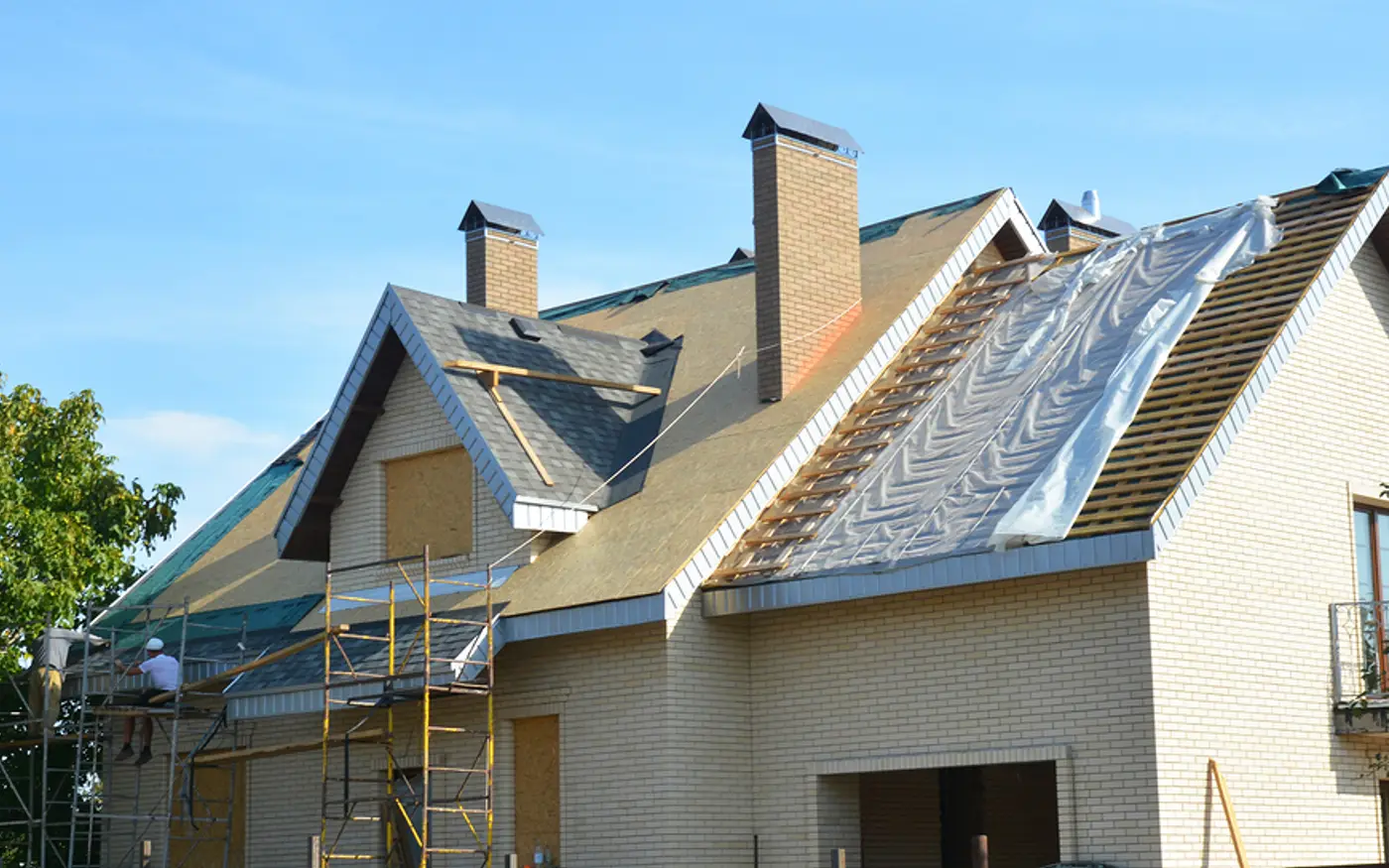
The South Main end of the street and the blocks around it hold brick and frame homes from the 1800s with steep gable roofs, and in places slate or tile. Those roofs behave nothing like the flat roofs a block away. They shed water fast, but they meet chimneys, dormers and cornices at awkward angles, and original slate or tile has to be matched rather than swapped for whatever is on the truck.
Roof problems we see downtown
- Parapet coping and wall flashing. Loose or cracked coping lets water into the top of the wall, and it comes out as staining on an interior wall or upstairs ceiling, sometimes far from where it got in.
- Ponding water. A century of settling, clogged drains and scuppers, or no tapered insulation leaves water standing on a flat roof, which wears out seams faster.
- Layered patches. Many downtown roofs carry decades of patching over each other. At some point the patches become the problem, and only a tear-down to the deck shows what's underneath.
- Rooftop equipment. HVAC units, vents and old penetrations each need curbs and flashing. Equipment also falls under the district's appearance rules if it's visible from the street.
- Gutters and downspouts on residences. The South Main guidelines require gutters and downspouts appropriate to the building's style, so a replacement shouldn't default to whatever profile is cheapest.
On a downtown building, the parapet decides whether the roof stays dry as much as the roof does.
Preservation rules for Main Street roofs
The city's Building Division lists replacing roof shingles as work that generally doesn't need a building permit. But inside the Historic Downtown and South Main districts, city code requires a Certificate of Appropriateness from the Historic Landmarks Preservation and Architectural Review Board for exterior changes that affect a significant architectural feature or the exterior appearance. The Board meets monthly at City Hall, 200 N. Second St., and reviews applications within 30 days.
The design guidelines for these districts, written in the late 1990s, set out what the Board weighs. Paraphrased:
- South Main: preserve roof forms, angle and orientation, along with brackets, cornices, parapets and bargeboards. Don't remove historic roofing that's in good condition, and replace with similar materials. Low-profile asphalt shingles are considered appropriate replacements for wood shingles. Tile or slate should be replaced with matching material whenever feasible. Historic colors are gray, black and brown.
- Historic Downtown: the same approach. Replacements should replicate the color, shadow lines, texture and pattern of the original, and tile or slate should be replaced in kind where feasible.
The guidelines also say maintenance that doesn't change the exterior appearance doesn't need Board approval. For a hidden flat roof, a membrane replacement is usually maintenance. Changing a parapet or cornice, adding visible rooftop equipment, or switching a residential roof from slate to something else is not. When in doubt, call the city's Historic Preservation office at 636-949-3228 before you schedule work. Our article on replacing a roof in a St. Charles historic district explains how the application works.
The river and the floodplain
Main Street runs along the Missouri River, and some river-edge lots are mapped in the floodplain while others are not. Check the FEMA flood map for your specific address. The city notes that a Floodplain Development Permit may be required for work in a floodplain, even for projects that don't otherwise need a building permit. A routine reroof is rarely affected, but structural work on a riverfront building is worth a call to the city first.
Storms on low-slope roofs
Hail hits flat roofs differently than shingles. It can bruise or puncture a membrane, crack coping, and dent metal flashing and rooftop units. The National Weather Service documented widespread golf-ball to baseball-size hail across St. Charles County on April 28, 2012, and hail up to 2.75 inches near St. Charles on May 26, 2024. Damage on a roof hidden behind a parapet often goes unnoticed until a leak shows up inside. After a storm, we photograph the roof with dates so you have a record to share with your insurer. See our storm and hail damage repair page for what we check.
What Main Street owners call us for
Flat-roof repair and replacement. Most of the downtown commercial buildings need low-slope work: membrane repairs, drain and scupper fixes, coping and wall flashing. That's the core of our commercial roofing service.
Leak tracing. Downtown leaks travel inside thick masonry walls before they show. A careful roof repair starts by finding the actual entry point, often at the parapet or a party-wall flashing rather than the roof field.
Historic residential roofs. For the steep-gabled homes along South Main, our historic home roofing work plans the material and detailing around the district guidelines, including matching slate or tile where the guidelines call for it.
Pre-purchase and condition checks. Buying a building downtown? A roof inspection looks at the membrane, drainage, parapets and rooftop equipment so the roof's condition is part of the deal, not a surprise after it.
Neighboring areas
Main Street connects directly to two other historic neighborhoods we work in all the time. North of Clark Street, Frenchtown has brick homes with parapet end walls and its own preservation guidelines. Up the hill to the west, the Midtown and Lindenwood neighborhoods have slate, standing-seam and steep Victorian roofs. Call (636) 242-5111, seven days a week from 8am to 8pm, to set up a time for us to look at your roof.
Frequently Asked Questions
What kind of roof do most Main Street buildings have?
Most of the historic commercial buildings downtown have flat or low-slope roofs set behind a brick parapet, so you can't see the roof from the street. Historically those were tarred or roll roofing. Today a low-slope roof like that is typically covered with a modern membrane, and its performance depends as much on the parapet coping, wall flashing and drains or scuppers as on the membrane itself.
Which historic district is my Main Street building in?
Two local districts cover the area. The Historic Downtown District runs roughly from Third Street to the river between Clark and Madison streets. The South Main Preservation District runs from the alley behind Second Street to the river, from Madison Street south to about Boonslick Road. Both also sit within the National Register's St. Charles Historic District. The city's preservation office can confirm which district applies to your address.
Do I need Landmarks Board approval to fix a flat roof downtown?
Usually not for maintenance that doesn't change how the building looks. The city lists replacing roof shingles as permit-exempt, and the district guidelines say maintenance doesn't need approval unless it changes the exterior appearance. A low-slope roof hidden behind a parapet is rarely visible. Changes to the parapet, cornice, rooftop equipment visible from the street, or the roof form are different and can require a Certificate of Appropriateness.
Can I replace wood shingles with asphalt on a South Main house?
The South Main guidelines describe low-profile asphalt shingles as appropriate replacements for wood shingles, in historic colors like gray, black and brown. Where a building has tile or slate, the guidelines ask that it be replaced with matching material whenever feasible. Because a material change can still affect the exterior appearance, it's worth confirming the plan with the city's preservation planner before the job is scheduled.
Why does water pond on my downtown roof?
Ponding on a low-slope roof usually comes from sagging structure, clogged internal drains or scuppers, or tapered insulation that was never installed. Standing water speeds up wear on the membrane and finds any weak seam. On older buildings the deck may have settled over a century. We look at the drainage path first, because a new membrane over the same low spot will pond the same way.
Is Main Street in the floodplain?
Some riverfront lots along the Missouri River are mapped in the floodplain and some aren't, so it has to be checked address by address on the FEMA flood map. The city notes that a Floodplain Development Permit may be required for work in a floodplain. A straightforward reroof is usually unaffected, but larger structural work on a river-edge building should be checked with the city first.