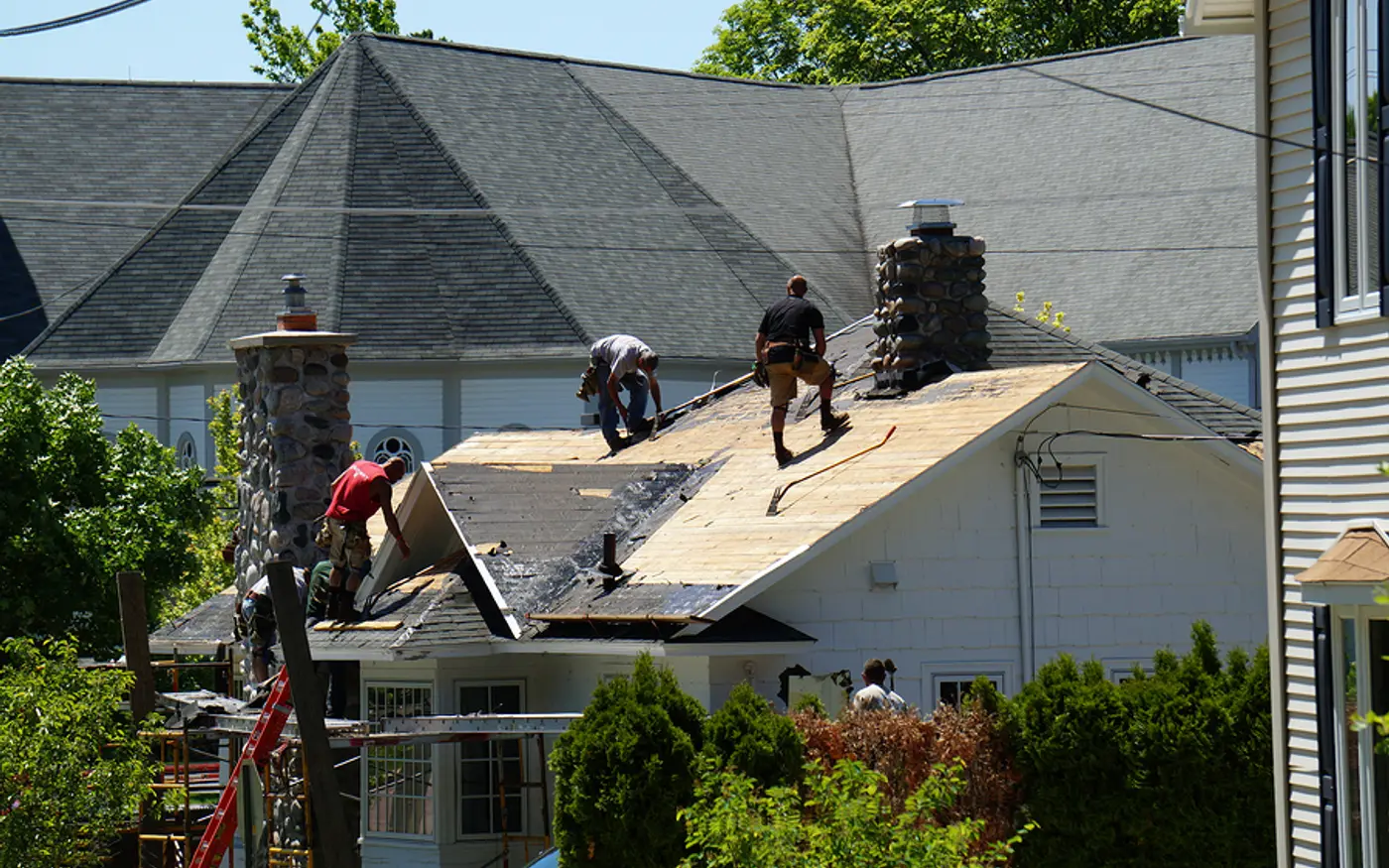
A roof replacement means tearing the old roof down to the decking, repairing the wood underneath, and building a new system of drip edge, underlayment, flashing, ventilation and shingles or metal. St. Charles Roofing Designs replaces roofs across St. Charles and nearby St. Charles County towns to the 2021 code and the manufacturer's instructions, with a free written quote first. Call (636) 242-5111.
When a roof needs replacing, not repairing
Most roofs don't fail all at once. They wear out a little at a time, and a targeted roof repair can carry a sound roof for years. Replacement makes sense when the problems are spread across the whole roof instead of one spot, when the shingles have simply reached the end of their life, or when a storm has damaged too much of the surface to patch.
Age is a good starting point. InterNACHI estimates put architectural shingles at about 30 years and 3-tab shingles at about 20. Here in St. Charles County, the code books rate our weathering as "Severe," and the National Weather Service counts 40 to 50 thunderstorm days a year in the St. Louis area. Hail, freeze-thaw winters and long humid summers all take a toll, so many roofs wear out before the number on the shingle wrapper.
Signs it's time for a new roof
- Curling, cupping or cracking shingles across whole slopes, not just a few tabs.
- Heavy granule loss. Bare, shiny patches on the shingles or piles of granules at the downspouts mean the asphalt is exposed to the sun.
- Leaks in more than one place, or leaks that come back after they've been repaired.
- Soft or spongy spots when walking the roof, or sagging between rafters, which usually means the decking is rotting.
- Daylight through the roof boards or dark water stains on the attic sheathing.
- Widespread hail bruising after a storm, where the mat under the granules is fractured on every slope.
- Two layers already on the roof. If the roof needs work and there are two layers, code requires a full tear-off anyway.
Not sure which side of the line your roof is on? A roof inspection answers that with photos, so you can make the call yourself.
How we replace a roof
Every replacement follows the same sequence. The order matters, because the parts you never see after the job are what decide whether the roof reaches its rated life.
- We look before we quote. We walk the roof, check the attic where we can get in, count layers, and photograph soft decking, flashing, chimneys and vents. You get a free written quote that explains what we found.
- We protect the house and yard. Tarps go over landscaping and against the walls, and a dumpster or trailer is staged close to the work.
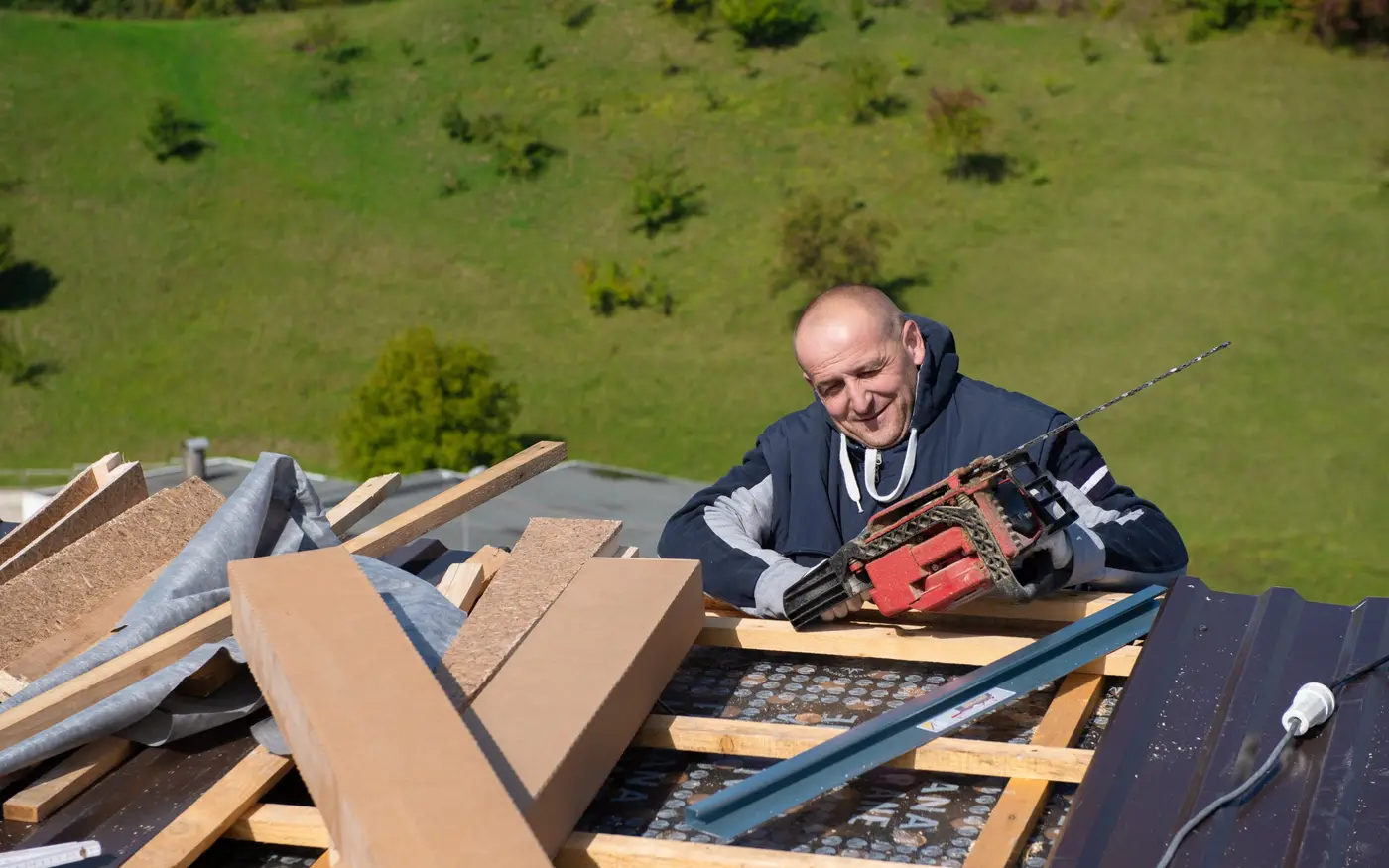
- We tear off to the decking. Old shingles, underlayment and worn flashing come off, so nothing is hidden under the new roof.
- We fix the wood. Rotted or delaminated sheathing gets cut out and replaced. On older St. Charles homes with board decking, we look at gaps between boards that may need new sheathing over them.
- We install drip edge and underlayment. Drip edge goes on the eaves and the rakes, as the county code requires, followed by underlayment and ice and water membrane in the vulnerable spots.
- We flash and ventilate. New step and counter flashing at walls and chimneys, new pipe boots, and balanced intake and exhaust ventilation for the attic.
- We install the roof covering. Shingles or metal go on to the manufacturer's nailing, exposure and starter requirements, followed by hip and ridge caps.
- We clean up and walk you through it. Nails, scrap and old shingles leave with us, and we go over the finished roof with you.
Code details that matter in St. Charles County
The City of St. Charles enforces the 2021 International Residential Code. Unincorporated parts of the county use the 2021 St. Charles County Residential Code, which is based on the same IRC with local amendments. A few of those rules shape every roof replacement we do.
Drip edge on the eaves and the rakes
The county's amendment requires drip edge at both the eaves and the rakes, lapped at least 2 inches and fastened no more than 12 inches apart. Underlayment goes over the drip edge at the eaves and under it at the rakes. Older roofs here often have no drip edge at all, which is one reason fascia boards and the first row of decking rot.
The two-layer limit
Under IRC R908.3.1.1, you can't recover a roof that already has two or more layers, or one that's water-soaked or deteriorated. Plenty of 1970s and '80s homes in St. Peters and Harvester already carry a second layer from an earlier re-roof, so a tear-off isn't optional on those.
Ice barrier: not required, still recommended
Both the city and county code tables say an ice barrier underlayment is not required in St. Charles County. We still use self-adhered membrane in valleys, around chimneys and skylights, at pipe penetrations, and on low-slope sections, because freeze-thaw cycles and wind-driven rain find those spots first.
Wind and slope
The county and city design for a 107 mph wind; St. Peters' own table uses 115 mph. That's why shingle wind ratings (ASTM D7158 Class H or D3161 Class F) and correct nailing matter. Asphalt shingles also need at least a 2:12 slope, with double underlayment from 2:12 up to 4:12, which comes up on porch roofs and additions.
The parts of a roof you never see after the job are the parts that decide how long it lasts.
Choosing the new roof
Most St. Charles homeowners choose architectural shingles, the dimensional shingle that has largely replaced the flat 3-tab look. If hail is the worry, an impact-rated shingle tested to UL 2218 Class 4 is worth pricing, though independent testing by IBHS shows Class 4 isn't hail-proof. For a roof meant to outlast the mortgage, metal roofing and stone-coated steel shingles cost more up front and last far longer. Our guide to Class 4 vs. Class 3 shingles compares the impact options.
| Roof type | Typical life (estimate) | Good fit for |
|---|---|---|
| 3-tab fiberglass shingles | About 20 years | Tight budgets, matching an existing look |
| Architectural shingles | About 30 years | Most homes in the county |
| Metal (standing seam or exposed fastener) | 40 to 80 years | Long-term owners, rural and low-slope sections |
| Stone-coated steel | Long life; see manufacturer warranty | Hail-prone roofs where a shingle or tile look is wanted |
Lifespans are InterNACHI estimates and vary with ventilation, installation and storms.
What drives the cost of a new roof
We don't publish a price list, because two roofs of the same square footage can be very different jobs. For a sense of scale, national cost guides put the average roof replacement around $9,500, with a range of roughly $5,800 to $46,000. One third-party estimate puts asphalt shingles in the St. Charles area at about $4 to $7 per square foot installed. Your number depends on:
- Size and pitch. Steep roofs need more safety setup and go slower.
- Complexity. Dormers, valleys, turrets, chimneys and skylights all add flashing work.
- Layers to remove. Two layers mean more labor and more disposal.
- Decking condition. You won't know the full extent until the old roof is off, so we explain up front how replacement sheathing is handled.
- Material. Architectural shingles, impact-rated shingles, metal and stone-coated steel are priced very differently.
- Ventilation upgrades such as adding ridge vent or intake vents.
Our full breakdown of what a new roof costs in St. Charles goes deeper, including how insurance fits in after a covered storm.
Roof replacement across St. Charles and nearby towns
The housing stock changes every few miles here, and so does the replacement plan.
Historic districts in the city
About half the homes near our South Fifth Street office were built before 1940. In Frenchtown and along Historic Main Street, that means steep brick houses with parapet walls, dormered mansards and chimneys the design guidelines say must stay. Replacing shingles like-for-like is generally maintenance, but changing a roof's material or appearance can require a Certificate of Appropriateness from the city's Landmarks Board. Our historic home roofing page covers that review.
1970s through 1990s subdivisions
St. Peters grew from 486 people in 1970 to more than 40,000 by 1990, and Harvester's housing is mostly from the 1970s, '80s and '90s. Many of those homes in St. Peters and Harvester are on their second or third roof. St. Peters' re-roofing requirements say a permit is needed when more than 25% of the sheathing is replaced or the roof changes to a different material, so confirm with the St. Peters Building Department before work starts.
Newer neighborhoods reaching their first replacement
The first homes in New Town at St. Charles went up from 2004 on, so those original roofs are now around 17 to 22 years old. New Town's architectural review form lists roofing, and no work may begin until written approval is received, so we provide the product specs and color samples you need for the form. Younger subdivisions in Cottleville are seeing first replacements too, often after hail.
Permits by town
The City of St. Charles lists replacing roof shingles among projects that generally don't need a permit, and the county lists replacing a roof the same way. Floodplain lots are the big exception: the county requires a floodplain development permit for reroofing in its regulated floodplain even when no building permit is needed. Our roof permit guide for St. Charles County walks through each town.
Storm damage and insurance
If hail or wind caused the damage, your homeowners policy may cover the replacement minus your deductible. The National Weather Service documented hail of 3 to 3.75 inches over St. Charles County on March 14, 2024, and 2.75-inch hail near St. Charles on May 26, 2024. We document what we find with dated photos you can share with your insurer. Missouri law also protects you: under RSMo 407.725, no roofer may offer to pay or rebate your deductible. If your roof took a hit, start with our storm and hail damage roof repair page.
Get a free written quote
If your roof is getting old, leaking in more than one spot, or took a beating in the last storm, let's take a look. We'll get on the roof, photograph what we find, and tell you honestly whether it needs replacing or whether a repair will do. Call (636) 242-5111, any day from 8am to 8pm, or use the quote form on this page. For businesses, see our commercial roofing services.
Frequently Asked Questions
How long does an asphalt shingle roof last in St. Charles?
InterNACHI's estimates put architectural shingles at about 30 years and traditional 3-tab shingles at about 20, with metal roofing in the 40 to 80 year range. In St. Charles County, hail, freeze-thaw winters and 90-degree summers often shorten those numbers, especially on roofs with poor attic ventilation. A roof that has reached 20 years or more is worth having looked at before the next storm season.
Can you put new shingles over my old roof?
Sometimes, but usually not. The 2021 International Residential Code, which St. Charles and the county enforce, does not allow a new roof over two or more existing layers, or over a roof that is water-soaked or deteriorated. Even when one layer could legally be covered, a tear-off lets us inspect and replace bad decking and install a proper drip edge and underlayment, so we usually recommend it.
Do I need a permit to replace my roof in St. Charles?
The City of St. Charles lists replacing roof shingles among projects that generally do not need a building permit. Homes in the city's historic districts may need Landmarks Board approval if the roof's appearance changes, and floodplain lots may need a floodplain development permit. St. Peters has its own re-roofing requirements, so confirm with your city or the county before work starts.
How much does a roof replacement cost?
National cost guides put an average roof replacement around $9,500, with a range from roughly $5,800 to $46,000 depending on size, pitch and material. One third-party estimate for the St. Charles area puts asphalt at about $4 to $7 per square foot installed. Those are not our prices. We give a free written quote after looking at your roof, decking and attic.
Is ice and water shield required in St. Charles County?
No. The St. Charles County and City of St. Charles code tables both say an ice barrier underlayment is not required here. We still recommend self-adhered ice and water membrane in valleys, around chimneys, skylights and pipe penetrations, and on low-slope sections, because those are where leaks start when ice dams or wind-driven rain hit a roof.
Will insurance pay for my roof replacement?
Only if a covered event such as hail or wind damaged the roof. Insurance does not pay for a roof that simply wore out. Many Missouri policies use a wind and hail deductible of 1% or 2% of the dwelling coverage, and some pay older roofs at actual cash value. Check your declarations page. We document what we find with dated photos you can share with your insurer.
What happens to my yard and landscaping during a tear-off?
Tear-off is messy, so we protect what we can before the old roof comes off, tarp beds and shrubs near the walls, and keep a dumpster or trailer close to the work. At the end of the job we clean up nails, scrap and old shingles, run a magnet over the yard and driveway, and walk the finished roof with you so you can see the work.