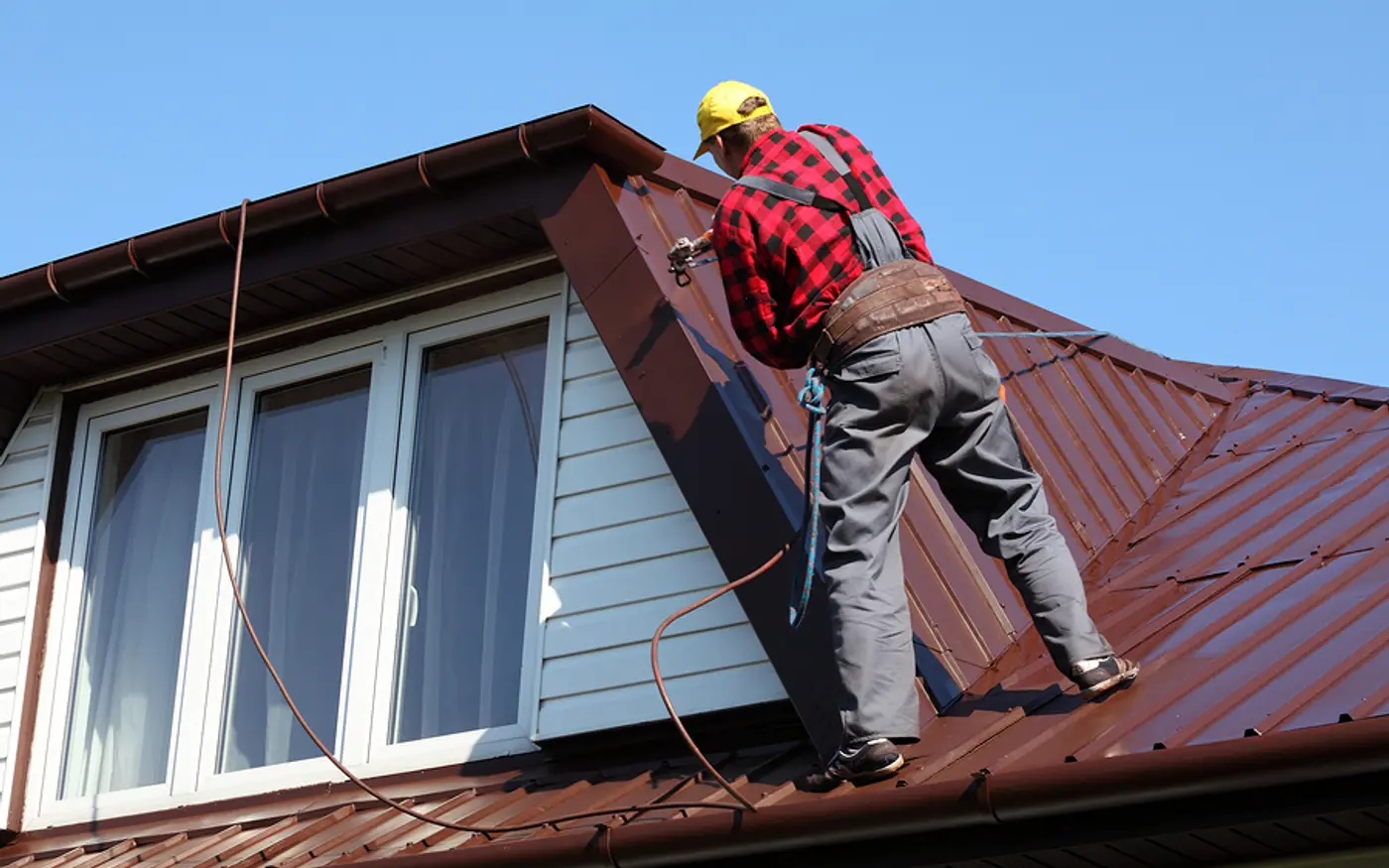
St. Charles Roofing Designs repairs and replaces low-slope and steep-slope commercial roofs in St. Charles, Missouri, from downtown buildings with flat roofs behind parapet walls to small offices with shingle or metal roofs. We look at the roof first, photograph what we find, and give you a free written quote. Call (636) 242-5111, 8am to 8pm, seven days a week.
Commercial roofing for St. Charles business owners
We're a residential-first roofer, and that shapes how we approach commercial work: straightforward explanations, photos of what we find, and a written scope you can take to a partner, a landlord or a lender. Our commercial work covers the kinds of buildings that make up most of St. Charles: storefronts and mixed-use buildings, small offices, churches, converted houses used as businesses, and the shops and offices that line the commercial corridors of St. Charles and St. Peters.
Commercial roofs fall into two broad groups, and the right approach depends on which one you have.
Low-slope roofs
Most downtown commercial buildings in St. Charles have flat or low-slope roofs behind parapet walls. The city's design guidelines for the Historic Downtown District note that these roofs were historically covered with tar or roll roofing. Today low-slope roofs across the industry are typically covered with a single-ply membrane or a multi-ply system, and they depend on continuous seams, solid flashing at every wall and penetration, and drainage that actually moves water off the roof.
Steep-slope roofs
Many smaller commercial buildings have pitched roofs much like a house: shingles, metal panels or standing seam over decking. These follow the same rules as a residential roof, including the 2:12 minimum slope for asphalt shingles, and they benefit from the same attention to flashing and ventilation we give homes. For these buildings we can also offer metal roofing or architectural shingles.
Signs your commercial roof needs attention
- Water stains on ceiling tiles, especially near walls, rooftop units or drains.
- Water standing on the roof 48 hours or more after rain.
- Blisters, bubbles, open seams, or cracked and alligatored surfacing.
- Loose, rusted or missing parapet coping, or counterflashing pulling away from brick.
- Clogged or damaged drains, scuppers, gutters or downspouts.
- Soft spots underfoot, which often mean wet insulation or deteriorated decking.
- Hail dents on rooftop units, vents and metal flashing after a storm.
- Leaks that move around, or that come back after being patched.
How we approach a commercial roof
- We look before we quote. We walk the roof, check drains, seams, parapets, curbs and penetrations, and look at the underside of the deck where we can get access. A thorough roof inspection is the starting point for every commercial job.
- We photograph what we find. You get dated photos of the problem areas, which helps when you need to explain the work to an owner, a tenant or an insurer.
- We tell you whether a repair will do. Many commercial leaks come from a handful of failed details. If a targeted roof repair will buy the building years, we'll say so. If the insulation is wet and the surface is worn out, we'll explain why a roof replacement is the better spend.
- You get a free written quote. The scope lists tear-off, decking repair, insulation, the roof surface, flashing, coping and drainage work.
- We build to code and the manufacturer's instructions. The City of St. Charles enforces the 2021 International Building Code for commercial work, and manufacturers publish detailed installation requirements for their systems.
- We clean up and walk you through it. Debris leaves with us, and we go over the finished roof with you or your building manager.
The details that decide whether a low-slope roof lasts
A flat roof doesn't shed water the way a steep roof does. It holds water longer and relies on every seam and edge to keep it out. These are the places we pay the most attention to.
Parapet walls, coping and counterflashing
The brick parapets on downtown St. Charles buildings are handsome, but they're also where many leaks start. Water gets in through cracked mortar, failed coping joints and base flashing that has pulled away from the wall. The fix is usually a combination of sound coping on top, membrane or flashing turned up the inside face of the wall, and counterflashing let into the brick to cover the top edge.
Drains and scuppers
Low-slope roofs drain through internal drains, through scuppers cut in the parapet, or to gutters at the edge. Leaves, debris and settling can block all three. When a roof is replaced, it is the right time to correct low spots and make sure water actually reaches the drains.
Penetrations and rooftop equipment
HVAC units, exhaust fans, plumbing vents and skylights all pierce the roof. Each needs a curb or boot and flashing that suits the roof system. In the city's Extended Historic Preservation District, the design guidelines call for rooftop mechanical equipment to be screened from public view, which is worth planning for before new equipment goes up.
Insulation and decking
Wet insulation loses much of its value and can hold water against the deck. Part of looking at a commercial roof is figuring out how far the water has spread, because it decides whether a repair is enough.
Codes, permits and rules for commercial roofs
Commercial roofing in St. Charles falls under a few overlapping sets of rules.
- Building codes. The City of St. Charles enforces the 2021 International Building Code and International Residential Code. Unincorporated St. Charles County uses the 2021 I-codes with county amendments.
- Permits. The city lists replacing roof shingles among projects that generally don't need a permit. Structural work, re-decking and changes to the roof system on a commercial building can be different, so call the city's Community Development office at 636-949-3222 before work begins. Other towns set their own rules, and our roof permit guide for St. Charles County covers the differences.
- Historic review. Exterior changes in the city's historic districts can require a Certificate of Appropriateness from the Landmarks Board. Our historic home roofing page explains how that review works.
- Floodplains. River-edge properties may need a floodplain development permit. The city notes one may be required, and St. Charles County requires one for reroofing in its regulated floodplain.
- Missouri law. RSMo 407.725 covers roofers working on commercial property as well as homes, including the ban on paying or rebating deductibles and the five-business-day cancellation right after a written claim denial.
Missouri does not license roofing contractors statewide. That makes it worth asking any contractor for a local address, a written scope, and an explanation of how they'll handle your building's drainage and flashing.
What drives commercial roofing cost
We don't publish prices because commercial roofs vary too much to price without seeing them. The things that move the number most are:
- Roof area and how many existing layers have to come off.
- How much insulation is wet and how much decking needs repair.
- The number of penetrations, curbs and rooftop units.
- The length and condition of parapet walls, coping and counterflashing.
- Drainage corrections such as added slope, new drains or scuppers.
- Access: street-front downtown buildings with no yard can need more planning for staging and debris removal.
- Historic district requirements that affect visible materials.
Commercial buildings we see around St. Charles
Downtown, along Historic Main Street and the South Main district, most commercial buildings have low-slope roofs hidden behind brick parapets, with the parapet flashing and drainage details that come with them. North Second Street in Frenchtown is the neighborhood's historic commercial spine, lined with shops that had living quarters above, so many of those roofs mix low-slope sections with steep residential roofs.
Farther out, the commercial corridors along Mid Rivers Mall Drive and Route 364 in St. Peters include Mid Rivers Mall, the county's largest shopping center, along with retail and office buildings that commonly have low-slope roofs, and St. Peters has its own building department and code tables, including a 115 mph design wind speed. The live/work buildings in New Town at St. Charles mix commercial space with residences, and roofing there goes through the New Town architectural review before work begins. In Cottleville, Highway N is the main road into Old Town Cottleville, and the city issues its own permits, so call Cottleville City Hall to confirm what a commercial reroof needs.
Hail affects commercial roofs too. After a storm, our storm and hail damage service covers documenting damage to roof surfaces, rooftop units and metal flashing with dated photos you can share with your insurer.
Next step
If your building has a leak, a ponding problem or a roof that's simply getting old, call (636) 242-5111 or send a request through the form on this page. We'll set up a time to look at the roof and give you a free written quote with a clear explanation of what we found.
Frequently Asked Questions
What kinds of commercial roofs do you work on?
We work on both low-slope and steep-slope commercial roofs. Low-slope roofs are the flat-looking roofs common on downtown storefronts, offices and strip buildings, usually behind parapet walls. Steep-slope commercial roofs look more like house roofs and are common on small offices, churches, mixed-use buildings and converted homes. We look at the roof first and tell you what it has and what it needs.
Can asphalt shingles go on a flat commercial roof?
No. Under the residential code used in St. Charles, asphalt shingles may only be installed on slopes of 2:12 or steeper, and slopes between 2:12 and 4:12 need a double layer of underlayment. A roof flatter than that needs a low-slope roofing system designed to shed water without relying on overlapping shingles, such as a membrane or multi-ply roof.
Do I need a permit for a commercial reroof in St. Charles?
The City of St. Charles lists replacing roof shingles among projects that generally do not need a permit, but commercial buildings, structural work and changes to the roof system can be different. Buildings in a historic district may also need Landmarks Board approval. Call the city's Community Development office at 636-949-3222 before work starts, and check with the city or county for properties outside St. Charles.
Why does water pond on my flat roof?
Ponding usually comes from clogged drains or scuppers, sagging decking, insulation that has compressed, or a roof that was built without enough slope toward the drains. Water that sits for days speeds up wear on most roof surfaces, adds weight, and finds any weak seam. Clearing drains helps, but persistent ponding often means the slope or drainage needs to be corrected when the roof is repaired or replaced.
Should I repair or replace my commercial roof?
If the leaks trace to a few failed seams, a damaged flashing or a single penetration, and the rest of the roof surface is sound and dry, a repair is often the right call. If the insulation underneath is wet across large areas, the surface is cracking or blistering throughout, or leaks keep moving around, replacement usually costs less over time. We photograph what we find so you can see the condition yourself.
Does Missouri's roofing law apply to commercial buildings?
Yes. RSMo 407.725 covers contractors repairing or replacing roof systems on residential or commercial property. It bars contractors from offering to pay or rebate an insurance deductible, and it gives property owners the right to cancel a contract funded by a property and casualty policy within five business days after the insurer denies all or part of the claim in writing.
How often should a commercial roof be checked?
A common practice is to have a low-slope roof looked at twice a year, typically in spring and fall, and after any major hail or wind storm. Drains and scuppers should be cleared of leaves and debris, and flashing at parapets, curbs and rooftop units checked. Catching a small open seam early is far cheaper than replacing wet insulation later.