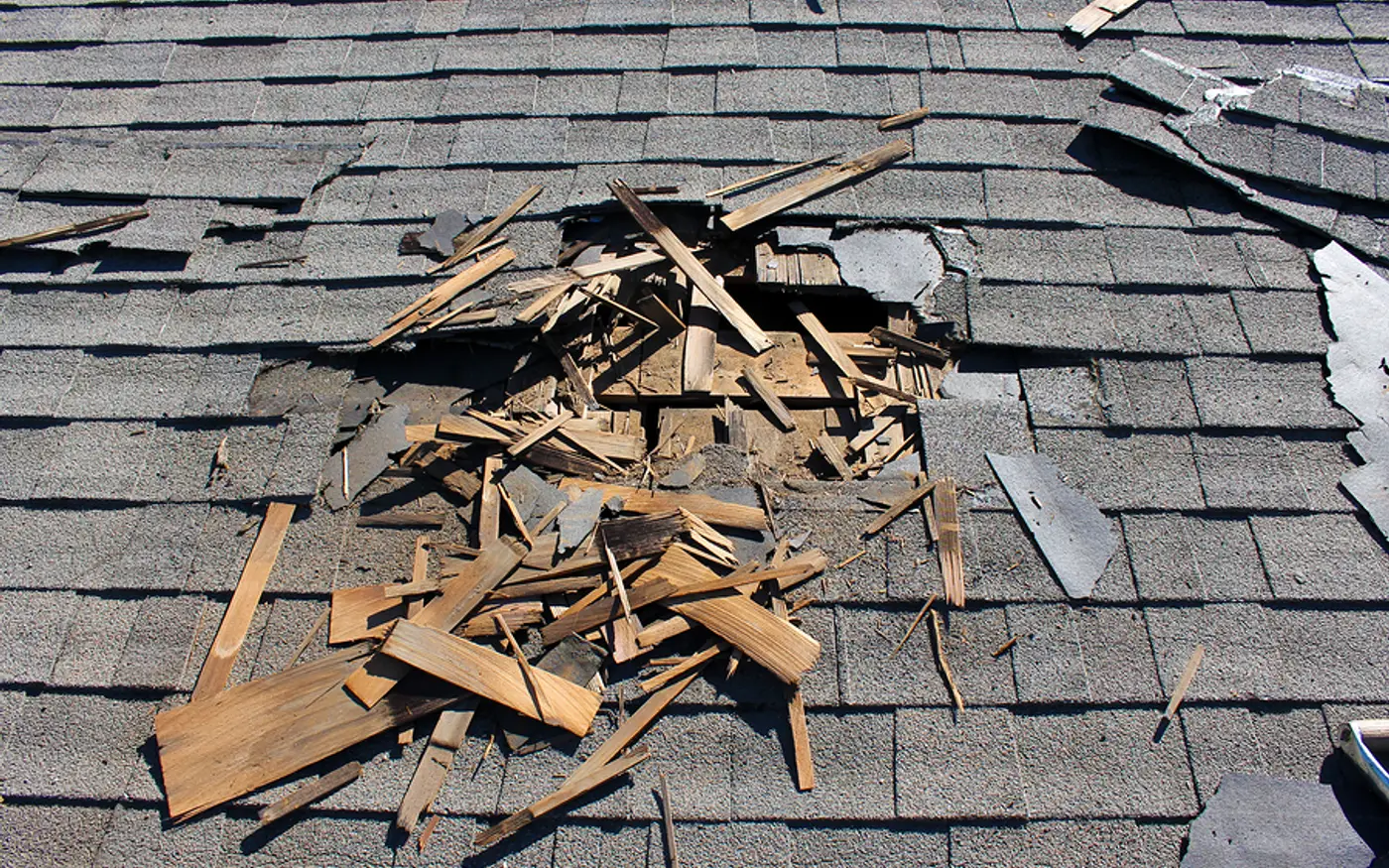
Class 4 shingles passed the toughest level of the UL 2218 impact test, a 2-inch steel ball dropped from 20 feet. Class 3 passed a 1.75-inch ball from 17 feet. In St. Charles, where the National Weather Service documented hail up to 3.75 inches in 2024, St. Charles Roofing Designs treats Class 4 as better protection, not hail-proofing. Some insurers offer discounts for both ratings.
How the UL 2218 impact test works
UL 2218 is the standard most shingle impact ratings come from. In the lab, a steel ball is dropped onto a shingle installed on a test deck, twice on the same spot, at several locations, including the shingle's weakest points. After the hits, the shingle is examined front and back. If there's no crack or tear, it passes that class. There are four classes:
| UL 2218 class | Steel ball diameter | Drop height |
|---|---|---|
| Class 1 | 1.25 in. | 12 ft |
| Class 2 | 1.5 in. | 15 ft |
| Class 3 | 1.75 in. | 17 ft |
| Class 4 | 2 in. | 20 ft |
So the step from Class 3 to Class 4 is real: a heavier ball dropped from higher, with a lot more impact energy. When people say "impact-resistant shingle," they almost always mean one tested to UL 2218 Class 4. Standard architectural and 3-tab shingles generally carry no impact rating at all.
What the test doesn't measure
- Real hail is ice, not steel. Hailstones vary in size, shape, hardness and speed, and wind drives them in at an angle. A dropped steel ball hits straight down.
- The test uses new shingles. A shingle that has spent ten summers in Missouri heat isn't the same as one fresh off the pallet.
- Pass/fail is about cracking. The test looks for cracks and tears. It doesn't grade granule loss or surface bruising, the kind of damage that shortens a roof's life and that insurers may treat differently.
- The rating covers the shingle, not the roof. Vents, skylights, gutters, flashing and siding can still be damaged.
Class 4 isn't hail-proof: what IBHS found
The Insurance Institute for Business and Home Safety (IBHS), a research group funded by insurers, runs its own hail tests with realistic, lab-made ice hailstones. In its 2025 shingle ratings, IBHS tested 24 impact-resistant shingle products, which together make up roughly 95% of that market. Most rated "Good." None rated "Excellent."
That doesn't mean impact-rated shingles are a waste of money. "Good" is better than what a standard shingle offers, and IBHS found real differences between products. It does mean the Class 4 label on the wrapper isn't a promise. A severe storm can still damage a Class 4 roof enough to need repairs or a claim.
A Class 4 rating means a shingle survived a 2-inch steel ball when it was new. St. Charles County has seen hail nearly twice that size.
Hail sizes in St. Charles County
Compare the test ball sizes with what the National Weather Service has actually documented here:
| Date | What the NWS documented | Compared with UL 2218 Class 4 (2 in.) |
|---|---|---|
| April 28, 2012 | Golf-ball to baseball-size hail across St. Charles County | Golf ball is smaller; baseball is larger |
| March 14, 2024 | Supercells over St. Charles County produced 3 to 3.75 in. hail; 3 in. hail photographed in O'Fallon | Up to almost twice the test ball |
| May 26, 2024 | Largest hail 2.75 in. near Saint Charles; 2.0 to 2.5 in. elsewhere in the county | At or above the test ball |
Those are the extremes. Most storms here bring smaller hail, and that's where impact-rated shingles earn their keep. A Class 4 shingle that shrugs off 1- to 1.5-inch hail can spare you a claim, a deductible and a re-roof. It won't save you from 3-inch stones. The NWS counts 40 to 50 thunderstorm days a year in the St. Louis area, and Missouri ranked second in the country for State Farm hail claims in 2025. For the full record, see our St. Charles County hail history, and for the March 2024 event, the National Weather Service St. Louis event summary.
Class 3 vs. Class 4 side by side
| Class 3 | Class 4 | |
|---|---|---|
| Test | 1.75 in. steel ball, 17 ft | 2 in. steel ball, 20 ft |
| Where you'll find it | Some shingle and other roofing products | Most products sold as "impact-resistant" |
| Insurance discounts | Some insurers recognize it | Some insurers recognize it; more commonly asked about |
| Hail-proof? | No | No |
In practice, most homeowners shopping for impact resistance end up comparing a standard architectural shingle with a Class 4 one. Many Class 4 shingles use rubber-modified (SBS) asphalt that stays more flexible and absorbs hits rather than cracking. Most look much like a standard architectural shingle from the street.
Insurance: discounts, deductibles and paperwork
Discounts
Some insurers offer premium discounts for roofs rated UL 2218 Class 3 or Class 4. Whether yours does, how much, and what proof it wants varies by company. Ask your agent before you pick a shingle, and keep the wrapper, invoice or product documentation showing the rating. The Missouri Department of Commerce and Insurance's "Raising the Roof" comparison tool shows how the top 20 Missouri insurers handle roof coverage.
Deductibles and roof age
Many Missouri policies now use a separate wind and hail deductible of 1% or 2% of the home's coverage amount. On a $100,000 home, the DCI's example puts a 2% deductible at $2,000. Some policies pay older roofs on an actual cash value basis, and the DCI warns that a 20-year-old roof may pay as little as 20% of replacement cost. Check your declarations page. A roof that avoids damage in a moderate storm saves you that deductible, which is the strongest financial case for impact-rated shingles.
Missouri's contractor rules
Whatever shingle you choose, Missouri law (RSMo 407.725) bars any roofer from offering to pay or rebate your deductible. It also lets you cancel a claim-funded roofing contract within five business days after your insurer tells you in writing that all or part of the claim isn't covered. Our guide to Missouri hail claims and your rights covers the details.
Is Class 4 worth it in St. Charles County?
It usually makes the most sense when:
- You plan to stay in the home for years, so you get the benefit through several hail seasons.
- Your insurer offers a discount for impact-rated roofs.
- Your home or neighborhood has had repeated hail claims.
- Your wind and hail deductible is large enough that avoiding one claim pays back the upgrade.
It makes less sense if you're selling soon, your carrier offers no discount, or the budget is better spent on decking, underlayment and ventilation, which matter for every roof. If you want more hail resistance than any shingle offers, look at stone-coated steel or metal roofing, keeping in mind that extreme hail can dent metal too.
The local angle: permits and historic districts
Switching from a standard shingle to an impact-rated shingle of the same style is generally a like-for-like re-roof. In the City of St. Charles, replacing roof shingles is on the list of projects that generally don't need a building permit. In Frenchtown and the other local historic districts, though, a change in the roof's appearance can require a Certificate of Appropriateness. Choose a color and profile close to what's there, and call the city's preservation line if you're unsure. In St. Peters, the city's re-roofing requirements say a permit is needed when more than 25% of the sheathing is replaced or the roofing material changes. Confirm with the St. Peters Building Department. In New Town, roofing goes through the architectural review form before work starts.
What to do next
- Call your insurance agent. Ask whether they offer an impact-rated roof discount, for which classes, and what proof they need.
- Get the roof looked at. If a recent storm hit, our storm and hail damage service documents what we find with dated photos you can share with your insurer.
- Compare options in writing. For a roof replacement, we'll quote standard architectural shingles alongside an impact-rated option so you can weigh the price difference against the discount and your deductible.
Call St. Charles Roofing Designs at (636) 242-5111, 8am to 8pm, seven days a week, or send a quote request. We'll look at the roof and give you a free written quote.
Frequently Asked Questions
What is the difference between Class 3 and Class 4 shingles?
Both ratings come from the UL 2218 impact test. A Class 3 shingle resisted a 1.75-inch steel ball dropped from 17 feet without cracking, and a Class 4 shingle resisted a 2-inch steel ball dropped from 20 feet. Class 4 is the highest rating in the test. Neither rating guarantees a shingle won't be damaged by real hail, which is often larger, faster and harder in some ways than the lab test.
Are Class 4 shingles hail-proof?
No. Class 4 means the shingle passed a specific steel-ball drop test when new. In 2025, the Insurance Institute for Business and Home Safety tested 24 impact-resistant shingle products, covering about 95% of the market, with realistic ice hailstones. Most rated Good and none rated Excellent. Large hail like the 2.75 to 3.75-inch stones the National Weather Service documented in St. Charles County in 2024 can still damage them.
Do Missouri insurers give discounts for Class 4 roofs?
Some do. Some insurers offer premium discounts for roofs rated UL 2218 Class 3 or Class 4, but the amount and the rules vary by company and policy, and not every carrier offers one. Ask your agent before you choose a shingle, find out what documentation they want, and keep the product wrapper or invoice that shows the rating. The Missouri Department of Commerce and Insurance also publishes a roof coverage comparison tool.
Are Class 4 shingles worth the extra cost in St. Charles?
Often, if you plan to stay in the home, your insurer offers a discount, or your neighborhood has had repeated hail claims. Missouri ranked second in the country for State Farm hail claims in 2025. They make less sense if you are selling soon or your carrier offers no discount. Compare the price difference against your wind and hail deductible, which on many policies is 1% or 2% of the home's coverage amount.
Can a Class 4 shingle look different from a regular architectural shingle?
Usually not by much. Many impact-rated shingles are made in the same dimensional, laminated style as standard architectural shingles, so they look similar from the street. Some use rubber-modified asphalt that stays more flexible. In the city's historic districts, any change in a roof's appearance may need Landmarks Board approval, so check color and profile with the city first.