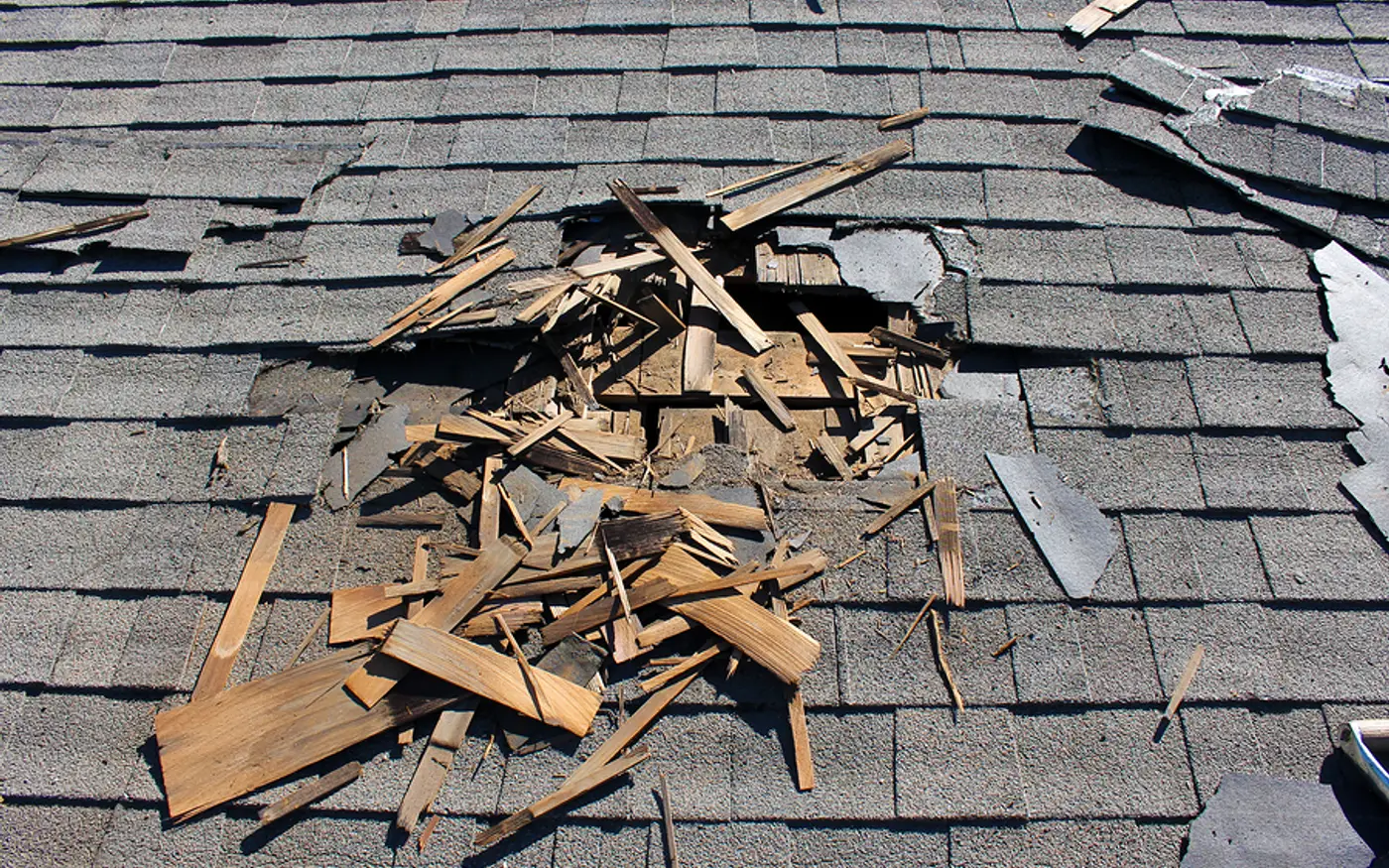
In Missouri, RSMo 407.725 protects homeowners filing roof claims: no roofer may offer to pay or rebate your deductible, and you can cancel a claim-funded roofing contract before midnight of the fifth business day after your insurer denies the claim in writing. St. Charles Roofing Designs explains how those rights, percentage hail deductibles and ACV versus RCV payouts work for St. Charles homeowners.
Why this matters in St. Charles County
Hail is not a rare event here. According to the National Weather Service, supercells over St. Charles County on March 14, 2024 produced hail of 3 to 3.75 inches, with 3-inch stones photographed in O'Fallon. Two months later, on May 26, 2024, the NWS logged 2.75-inch hail near Saint Charles and spotter-estimated 70 mph winds in Saint Peters. Our St. Charles County hail history walks through those storms and older ones, including the April 28, 2012 event that dropped golf-ball to baseball hail across the county.
Missouri as a whole ranked second in the country for State Farm hail claims in 2025, behind only Texas. Every big storm brings a wave of claims, a wave of door-knockers, and a lot of confusion about what a homeowner's rights actually are. This guide covers the law, the policy language and the practical steps, in that order.
One note before we start: this article explains Missouri law in general terms and is not legal advice.
RSMo 407.725: Missouri's roofing-contract law
Missouri does not license roofing contractors at the state level. What it does have is a consumer-protection statute aimed squarely at roof work paid for by insurance. Section 407.725 of the Revised Statutes of Missouri applies to contractors who repair or replace roof systems on residential or commercial property. It has four parts that matter to you.
1. No deductible rebates or inducements
A contractor may not advertise or promise to pay or rebate any part of an insurance deductible. The statute closes the obvious workarounds: the rebate cannot be dressed up as an allowance, a discount, a gift, a coupon or a credit offered as an inducement to sign. If a roofer says "we'll take care of your deductible," "we'll knock the deductible off," or "we'll give you a credit equal to your deductible," that is the conduct the law prohibits.
The reason is simple. Your deductible is your share of the loss. When a contractor "absorbs" it, the money usually comes from somewhere else, often an inflated estimate sent to your insurer, and you are the one who signed the claim.
2. A five-business-day right to cancel after a denial
If your roofing contract is to be paid from a property and casualty policy, you may cancel it before midnight of the fifth business day after you receive written notice from your insurer that all or part of the claim is not covered. This protects you from being locked into a full roof replacement you now have to pay for yourself because the claim came back denied or partly denied.
Note the trigger: the clock starts when you receive the insurer's written notice, not when an adjuster says something on the roof. Weekends and legal holidays generally do not count as business days.
3. A boldface notice and a detachable cancellation form
Before you sign, the contractor must give you a statement of this cancellation right in boldface type, along with a separate, detachable form titled "Notice of Cancellation." If a roofer hands you a one-page contract with no cancellation language and no tear-off form, that contract does not do what Missouri law requires.
4. A 10-day refund, with one exception
If you cancel, the contractor must return all payments within 10 days. The exception is emergency services, such as tarping a damaged roof to stop water from getting in, that you acknowledged in writing. Those can be kept, which is fair: the work was done and it protected your house.
A legitimate claim-funded roofing contract in Missouri should never mention covering your deductible, and it should include a boldface cancellation statement and a detachable Notice of Cancellation form. If either is wrong, stop before you sign.
Your deductible: flat dollars or a percentage
Older homeowner policies usually had one flat deductible for everything. Many policies now carry a separate wind and hail deductible written as a percentage of the dwelling coverage (Coverage A), commonly 1% or 2%. The Missouri Department of Commerce and Insurance (DCI) uses a simple example: a 2% deductible on a $100,000 home is $2,000.
| Dwelling coverage | 1% wind/hail deductible | 2% wind/hail deductible |
|---|---|---|
| $100,000 | $1,000 | $2,000 (DCI's example) |
| $250,000 | $2,500 | $5,000 |
| $400,000 | $4,000 | $8,000 |
The math is straightforward, but the surprise is real. A homeowner who remembers a "$1,000 deductible" may find the hail deductible is several times that. Pull your declarations page now, before a storm, and find two numbers: the wind and hail deductible and the roof payout basis.
ACV vs. RCV: how your roof will be paid
The second number decides how much of a new roof your policy actually buys.
- Replacement cost value (RCV) pays what it costs to replace the damaged roof with a comparable new one, minus your deductible. Many RCV policies pay in two steps: an initial check for the depreciated value, then the withheld depreciation once the work is completed and documented. Read your policy for its exact terms.
- Actual cash value (ACV) subtracts depreciation for age and wear before paying. DCI warns that on an ACV basis, a 20-year-old roof may pay as little as 20% of the cost to replace it.
Some policies switch an older roof to ACV automatically, or apply a roof-age payment schedule. DCI's "Raising the Roof on Insurance Coverage" tool compares how the 20 largest homeowner insurers in Missouri cover roofs. It is worth ten minutes, especially if you are shopping for a policy or your roof is approaching 15 to 20 years old.
The two numbers that decide a hail claim, the deductible and the payout basis, are on your declarations page long before the storm arrives.
Some insurers also offer a premium discount for roofs rated to UL 2218 Class 3 or Class 4 impact resistance. Whether yours does, and by how much, is a question for your agent. Our comparison of Class 4 vs. Class 3 shingles explains what those ratings test and why even a Class 4 roof is not hail-proof.
Storm-chaser red flags
After a big hailstorm, crews from out of state arrive within days. Some are fine. Many are gone before the first leak shows up. Watch for these signs:
- An offer to cover, waive or "work with" your deductible. In Missouri that is prohibited by RSMo 407.725, full stop.
- Pressure to sign on the spot, before your insurer has inspected or before you have read the contract.
- A contract with no boldface cancellation statement and no detachable Notice of Cancellation form.
- Language that signs your claim over to the contractor or authorizes them to act for you with your insurer. Read every line; you can keep control of your own claim.
- A large cash deposit up front, especially before materials are delivered.
- No local address, a phone number that goes to voicemail in another state, or a business name you cannot find. Missouri has no state roofing license to look up, but businesses register with the Missouri Secretary of State, and you can search that registry.
- Damage that only they can see. Ask for photos of every hit they point to, and compare them with soft metals like gutters, vents and downspouts, where real hail usually leaves marks too.

What to do after hail hits your roof: step by step
- Stay off the roof. Wet, hail-scattered shingles are slick. Look from the ground and from inside instead.
- Write down the date and time, and photograph what you can. Hailstones next to a coin or ruler, dents in gutters, downspouts, mailbox, car and siding, and any water stains on ceilings. Your phone's timestamp helps.
- Prevent further damage. If water is coming in, a temporary tarp or emergency patch protects the house. Policies generally expect you to take reasonable steps to limit additional damage. Keep receipts, and if a contractor does the work, get it acknowledged in writing as emergency service.
- Read your declarations page. Find the wind and hail deductible and whether the roof is covered at RCV or ACV. That tells you whether a claim is likely to be worth filing.
- Have the roof looked at. A roof inspection by a local roofer tells you whether you have real storm damage, how widespread it is, and whether it is a repair or a full roof replacement. We document what we find with dated photos you can share with your insurer.
- Report the claim to your insurer within the time your policy allows, and ask for the adjuster's inspection date. You decide whether you want your roofer present.
- Wait for the written decision. Compare the insurer's estimate with your contractor's written quote line by line. Differences in roof size, layers, drip edge, ice and water shield and code items are common and worth asking about.
- Sign only a compliant contract. It should spell out the scope and materials, include the boldface cancellation notice and detachable form, and say nothing about covering your deductible.
- Keep the paperwork. Final invoices, photos of completed work and material receipts are what many RCV policies need before releasing withheld depreciation.
Local details that change the claim
A few St. Charles County specifics can affect the scope of a hail-damage roof. County and city residential codes require drip edge at both eaves and rakes on shingle roofs, and the IRC does not allow a new layer over two existing layers, so a third roof means a full tear-off. Those items belong in an estimate when they apply.
Location matters too. Homes in Frenchtown and the city's other local historic districts may need Landmarks Board approval if the replacement changes the roof's appearance, which is a good reason to talk materials over before you sign anything; our page on roofing in Frenchtown covers that review. In fast-growing towns like Cottleville and St. Peters, many homes are on their first or second roof, and a young roof with real hail damage is often a strong candidate for RCV coverage. St. Peters also publishes its own re-roofing requirements, so confirm with the city before work starts.
What to do next
If a storm just came through, start with the steps above and a look at your declarations page. When you want a second set of eyes, our storm and hail damage roof repair page explains how we check a roof after hail and what we photograph. If the damage calls for a new roof, ask about impact-rated architectural shingles or stone-coated steel, which some insurers recognize with a discount.
Call St. Charles Roofing Designs at (636) 242-5111, 8am to 8pm, seven days a week, for a free written quote. The claim stays yours; we give you clear findings and photos to work with.
Frequently Asked Questions
Can a roofer pay my insurance deductible in Missouri?
No. Under RSMo 407.725, a contractor repairing or replacing a residential or commercial roof may not advertise or promise to pay or rebate any part of your property insurance deductible. That includes disguising the rebate as an allowance, discount, gift, coupon or credit offered as an inducement. A roofer who offers to cover your deductible is telling you, up front, that they are willing to break Missouri law.
How long do I have to cancel a roofing contract if my claim is denied?
If your roofing contract is to be paid from a property or casualty policy, Missouri law lets you cancel before midnight of the fifth business day after you receive written notice from your insurer that all or part of the claim is not covered. The contractor must refund your payments within 10 days of cancellation, except payments for emergency services you acknowledged in writing.
What is a percentage wind and hail deductible?
Instead of a flat dollar amount, many policies set the wind and hail deductible as a percentage of the dwelling coverage, often 1% or 2%. The Missouri Department of Commerce and Insurance gives the example of a 2% deductible on a $100,000 home, which works out to $2,000. On a home with higher dwelling coverage, the dollar figure rises with it. Check your declarations page for the exact percentage and amount.
What is the difference between ACV and RCV roof coverage?
Replacement cost value (RCV) coverage pays to replace the damaged roof with a comparable new one, minus your deductible. Actual cash value (ACV) coverage subtracts depreciation for the roof's age and wear first. The Missouri Department of Commerce and Insurance warns that on an ACV basis a 20-year-old roof may be paid at as little as 20% of the cost to replace it.
Should I sign a contract with a roofer before my adjuster comes out?
You are not required to, and it is usually wise to wait. Get the roof looked at, keep the photos, and let your insurer inspect and issue a written decision first. If you do sign earlier, make sure the contract includes the boldface cancellation statement and detachable Notice of Cancellation form Missouri law requires, so you keep your right to cancel if the claim is denied.
Does St. Charles Roofing Designs handle insurance claims?
No. The claim is between you and your insurance company, and you stay in charge of it. What we do is look at the roof, give you a free written quote, and document what we find with dated photos you can share with your insurer. If the damage turns out to be minor or not storm-related, we will tell you that too.