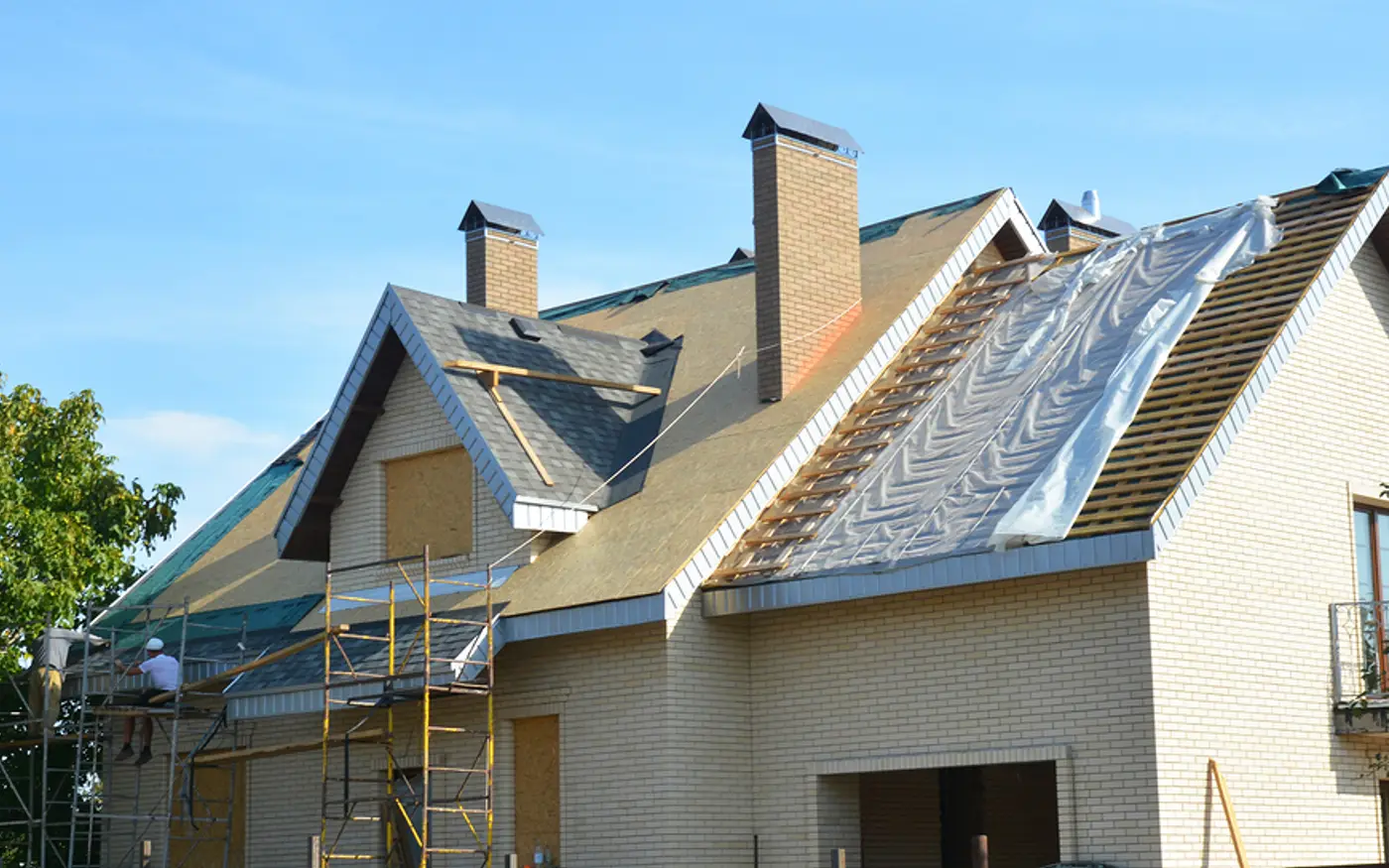
St. Charles Roofing Designs replaces and repairs roofs in New Town at St. Charles, the planned neighborhood off Highway 370. Before any New Town roof work starts, the NTGA architectural review board must approve it in writing; a like-for-like shingle replacement generally needs no City of St. Charles permit. Many of the first 2004–2008 roofs are now reaching replacement age. Call (636) 242-5111 for a free written quote.
About New Town at St. Charles
New Town is a traditional neighborhood development inside the City of St. Charles, reached from Highway 370. It was planned by the town-planning firm Duany Plater-Zyberk & Co. after a 2003 design charrette and developed by Whittaker Homes, with groundbreaking in October 2003. The plan covers roughly 747 acres assembled from six farms and calls for about 5,700 homes, laid out around some 90 acres of lakes and canals that double as the neighborhood's stormwater system.
It caught on fast. New Town was named the top-selling development in a 16-state survey in 2005–06, which is exactly why so many of its roofs are now the same age. The neighborhood is served by the Orchard Farm R-V school district, which also covers much of north St. Charles County.
New Town homes and the roofs on them
Walk a few New Town blocks and you'll see most of the neighborhood's building types: cottages, rowhouses, carriage houses over garages, larger single-family homes and live/work buildings with a shop or office below. The styles lean Craftsman and traditional river-town, with fiber-cement siding on many houses. Census figures put the median year built in the area around 2012, and nearly every home dates from 2000 or later.
The roofs follow the architecture. Expect steep traditional gables, front porches with their own roofs tied into the main wall, dormers, and on the attached homes, a single roof line that runs across several owners' units. Most are asphalt shingle, which is why the bulk of our New Town work is architectural shingle replacement.
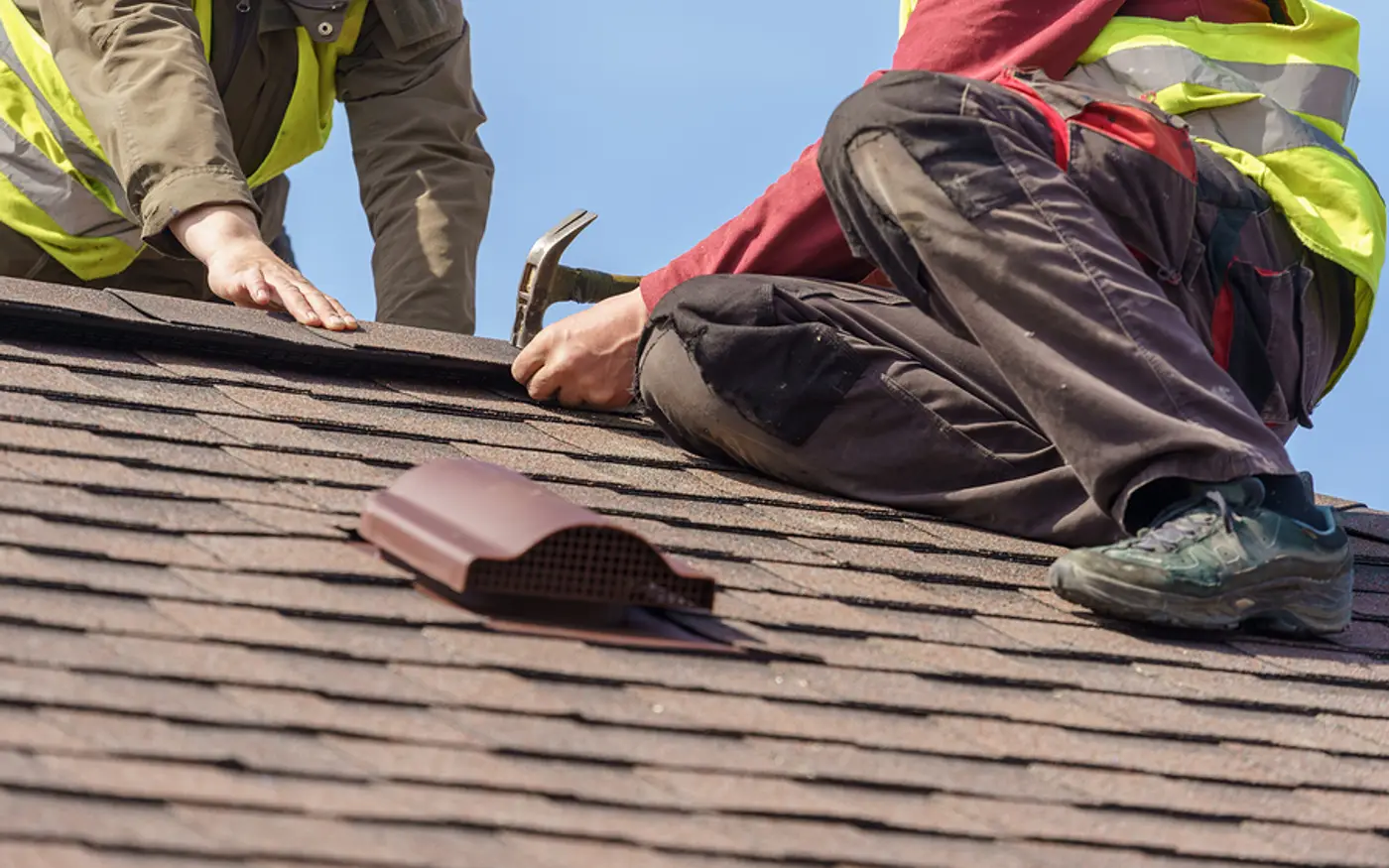
Roof problems we look for in New Town
The first roofs are reaching replacement age
Homes built in the first wave, roughly 2004 through 2008, are now on roofs about 17 to 22 years old. InterNACHI estimates a typical life of about 30 years for architectural shingles and about 20 for 3-tab, and builder-grade shingles exposed to St. Charles County's freeze-thaw winters and summer heat don't always reach the top of that range. Common signs are granules collecting in gutters, shingle edges that have started to curl, and brittle tabs that crack when lifted.
Rowhouse and party-wall tie-ins
On attached homes, your roof and your neighbor's are often one continuous surface. That is fine until one owner replaces and the other doesn't. The new roofing has to tie into the old at the property line so that water sheds across the joint instead of into it, and any flashing at the party line needs replacing, not reusing. Color is the other issue: a brand-new shingle next to an 18-year-old weathered one will look different even in the same color name.
Porch roofs, sidewalls and fiber-cement siding
Front porches are a signature of New Town's design, and every one is a place where a lower roof meets a wall. Those joints depend on step flashing and a kick-out flashing that steers water into the gutter rather than behind the siding. When that detail is missing or has failed, water stains show up on porch ceilings or the siding at the bottom of the roof line. A targeted roof repair usually fixes it if the decking underneath is still sound.
Pipe boots and vents
Rubber pipe-boot collars tend to crack long before the shingles around them are worn out. On roofs approaching 20 years, they are among the most common leak sources we find, and among the cheapest to fix.
NTGA architectural review and city permits
New Town's homeowners association, the New Town at St. Charles General Assembly (NTGA), uses an Architectural Review Form, and roofing is one of the project types it lists. The form asks for a plot plan, photos, a description of the work and construction detail. The architectural review board can take up to two weeks, and the form is explicit: no work may begin until written approval has been received.
Submit the NTGA form first and wait for written approval. Check the current NTGA standards for any material or color rules. We'll provide the product specifications and color samples you need to fill out the form.
NTGA approval doesn't replace city rules. Because New Town is inside the City of St. Charles, the city's Building Division applies, and it lists replacing roof shingles among the projects that generally do not require a permit. Work that changes the structure, such as replacing rafters, adding a skylight or changing pitch, likely does; call the city's Community Development office at 636-949-3222 if your project goes beyond shingles. The city also notes that a Floodplain Development Permit may be required on floodplain lots, so ask the city if you're unsure about your address. Our roof permit guide for St. Charles County covers the rules town by town.
On the code side, the city enforces the 2021 International Residential Code with a 107 mph design wind speed and a "Severe" weathering rating. Ice barrier underlayment is not required by the city's code tables, but we still install it in valleys and around penetrations, along with drip edge at the eaves and rakes.
Weather that reaches New Town roofs
New Town's open lakes and wide streets don't do much to slow a storm. According to the National Weather Service, supercells over St. Charles County on March 14, 2024 produced hail of 3 to 3.75 inches, and on May 26, 2024 the largest hail reported was 2.75 inches near Saint Charles. In November 2024 the Weather Service confirmed an EF-0 tornado along a six-mile track in northwestern St. Charles County that caused minor roof damage to homes. After a hail or wind event, our storm and hail damage service starts with dated photos you can share with your insurer.
Roofing services New Town homeowners ask for
Most calls from New Town fall into a few categories:
- First full replacement. For a 2004–2008 home, a roof replacement means tearing off the original builder shingles, replacing any soft decking, and rebuilding the details that age first: valleys, sidewall flashing and vents.
- Shingle upgrades. Many owners move from builder-grade to a heavier architectural shingle, sometimes with a UL 2218 Class 4 impact rating, which some insurers recognize with a discount.
- Leak repairs on porches and dormers. Localized repairs at porch tie-ins, pipe boots and dormer walls are often all a younger roof needs.
- A second opinion. If you're buying or selling, or a neighbor just re-roofed, a roof inspection tells you where your roof stands before you file anything with the NTGA.
Cost questions come up first, and the honest answer is that it depends on size, pitch, decking and material. Our guide to what a new roof costs in St. Charles walks through national figures and the factors that move the price. Your actual number comes from a free written quote after we look at the roof.
In New Town, the roof plan starts with the review form, not the dumpster.
Nearby areas we serve
New Town sits at the northern edge of the city, and many of our nearby jobs are just up Highway 94 in the farm country of Orchard Farm and north St. Charles County, where county permit rules apply instead of the city's. Farther north on the river, we also work in Portage des Sioux and West Alton, where floodplain permits are a bigger part of the conversation. Wherever you are, call (636) 242-5111, 8am to 8pm, seven days a week.
Frequently Asked Questions
Do I need HOA approval to replace my roof in New Town?
Yes, plan on it. The New Town at St. Charles General Assembly (NTGA) Architectural Review Form lists roofing among the projects it covers, and the form states that no work may begin until written approval has been received. The review can take up to two weeks, so submit the form before you set an install date. Check the current NTGA standards for any material or color requirements.
Do I also need a City of St. Charles permit for a New Town re-roof?
New Town is inside the City of St. Charles, and the city's Building Division lists replacing roof shingles among projects that generally do not require a permit. NTGA approval does not replace city permits, though. Structural work such as replacing rafters, adding a skylight or changing the roof pitch is a different matter, so call the city's Community Development office at 636-949-3222 if your project goes beyond shingles.
My New Town house was built around 2005. Does it need a new roof yet?
Not automatically, but it is worth a look. The first New Town homes went up after the 2003 groundbreaking, so those roofs are now roughly 17 to 22 years old. InterNACHI estimates about 30 years for architectural shingles and about 20 for 3-tab, and hail can shorten either. We look at the roof, photograph what we find and tell you whether a repair will carry it for a few more years.
How do you replace one rowhouse roof without damaging the neighbor's?
We plan the tie-in at the property line before tear-off starts. The old roofing on your side comes off up to that line, the new underlayment and shingles are woven or lapped into the adjoining roof so water sheds across the joint, and any flashing at the party line is replaced. Talking with your neighbor first helps, and sometimes adjoining owners choose to re-roof together.
What should a New Town roof quote include?
A useful quote names the shingle line and color, the underlayment, ice and water protection at valleys and penetrations, drip edge at eaves and rakes, ventilation, flashing at sidewalls and porch tie-ins, and how decking repairs are priced. Those product details are also what the NTGA review form asks you to describe, so one document can serve both purposes. Our written quotes are free.
Which neighborhoods near New Town do you also serve?
New Town sits in the Orchard Farm R-V school district in the northern part of the city, and we also work throughout north St. Charles County, including Orchard Farm, Portage des Sioux and West Alton. Our office is on South Fifth Street in St. Charles, and we answer the phone from 8am to 8pm, seven days a week, at (636) 242-5111.