St. Charles Roofing Designs replaces and repairs roofs across St. Peters, Missouri, from Spencer Creek and Mill Wood to the newer neighborhoods near 370 Lakeside Park. St. Peters' published re-roofing requirements call for a permit when more than 25% of the sheathing is replaced or the roofing material changes, and the city's code uses a 115 mph design wind speed. Call (636) 242-5111 for a free written quote.
About St. Peters
St. Peters sits directly west of St. Charles along Interstate 70, and with 57,732 residents in the 2020 census it is one of the largest cities in St. Charles County. It incorporated in 1910 and became a city in 1959, but for most of its history it was small: 486 people in 1970. Then it exploded, reaching about 15,700 in 1980 and 40,660 in 1990.
The main corridors are I-70, Mid Rivers Mall Drive, Route 364, Highway 94 and Highway 370. Mid Rivers Mall, the county's largest shopping center, anchors the middle of town. The St. Peters Rec-Plex hosted the 2004 U.S. Olympic Diving Trials, and 370 Lakeside Park covers 500 acres around a 140-acre lake with a 5.5-mile trail. The city maintains 27 parks with more than 1,200 acres and 30-plus miles of trails. Students attend Fort Zumwalt schools, including Fort Zumwalt South and East high schools, or Francis Howell schools such as Francis Howell North.
St. Peters housing and typical roofs
That 1970s-to-1990s boom shaped the housing. Many St. Peters homes were built during those decades: ranches, split-levels, bi-levels and two-story colonials in builder subdivisions, with gable and hip roofs, attached garages and asphalt shingles. Mill Wood dates to about 1976. Spencer Creek, with its West Village, South Village and Nob Hill sections, was built roughly 1977 to 1983.
A house from that era has usually been re-roofed at least once and is often on its second or third roof. Many of the original 3-tab roofs have been replaced with architectural shingles, and some houses still carry two layers from an earlier overlay.
Roof problems we see in St. Peters
Aging decking under older roofs
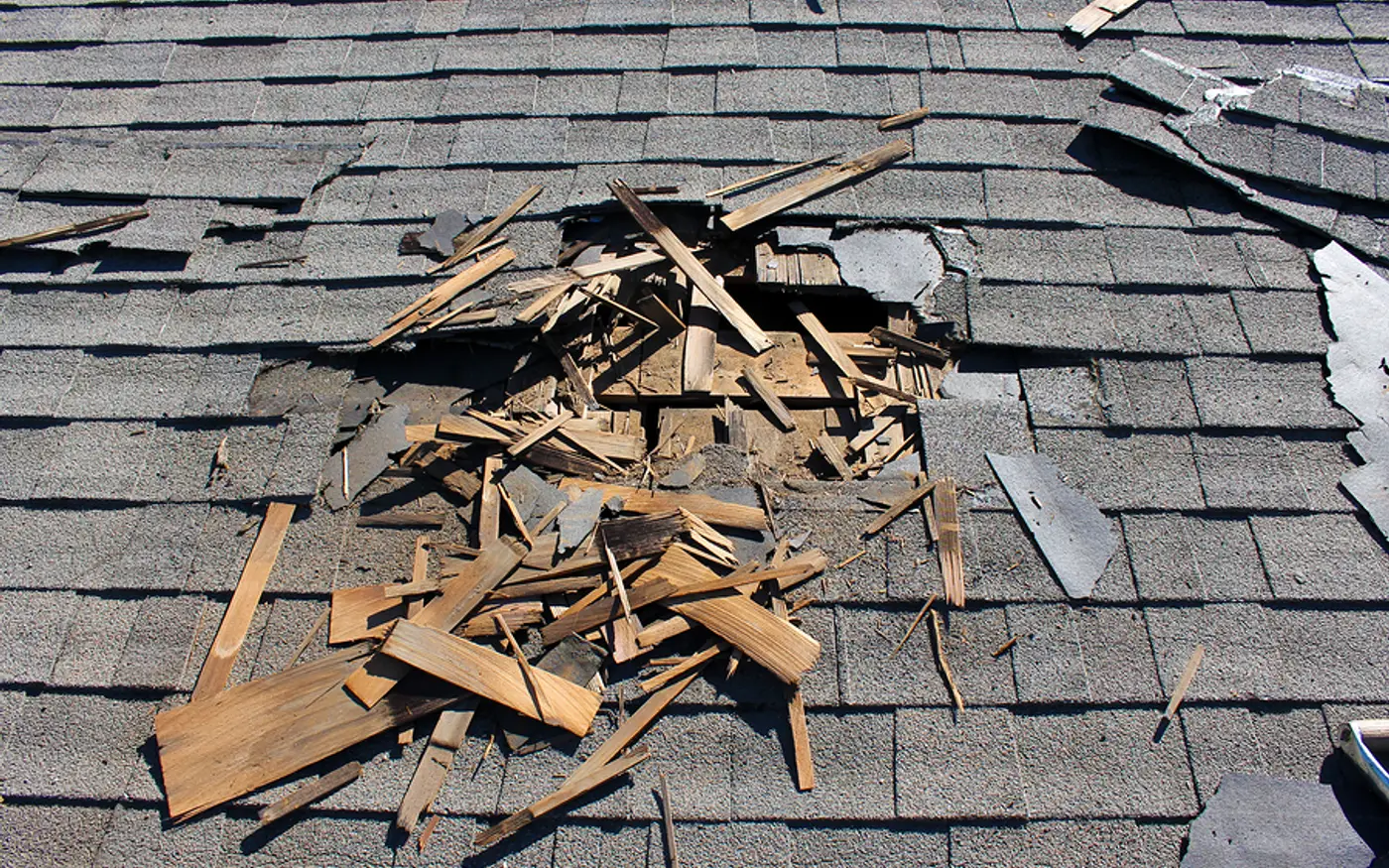
Forty-plus years of roofs, leaks and attic moisture take a toll on sheathing. On older homes, the decking may be plank boards rather than plywood or OSB, and gaps between boards can be too wide to nail shingles properly. Soft decking near eaves, valleys and chimneys is common. This is the detail that most often affects a St. Peters job, because it is tied to the city's permit trigger.
Two layers and full tear-offs
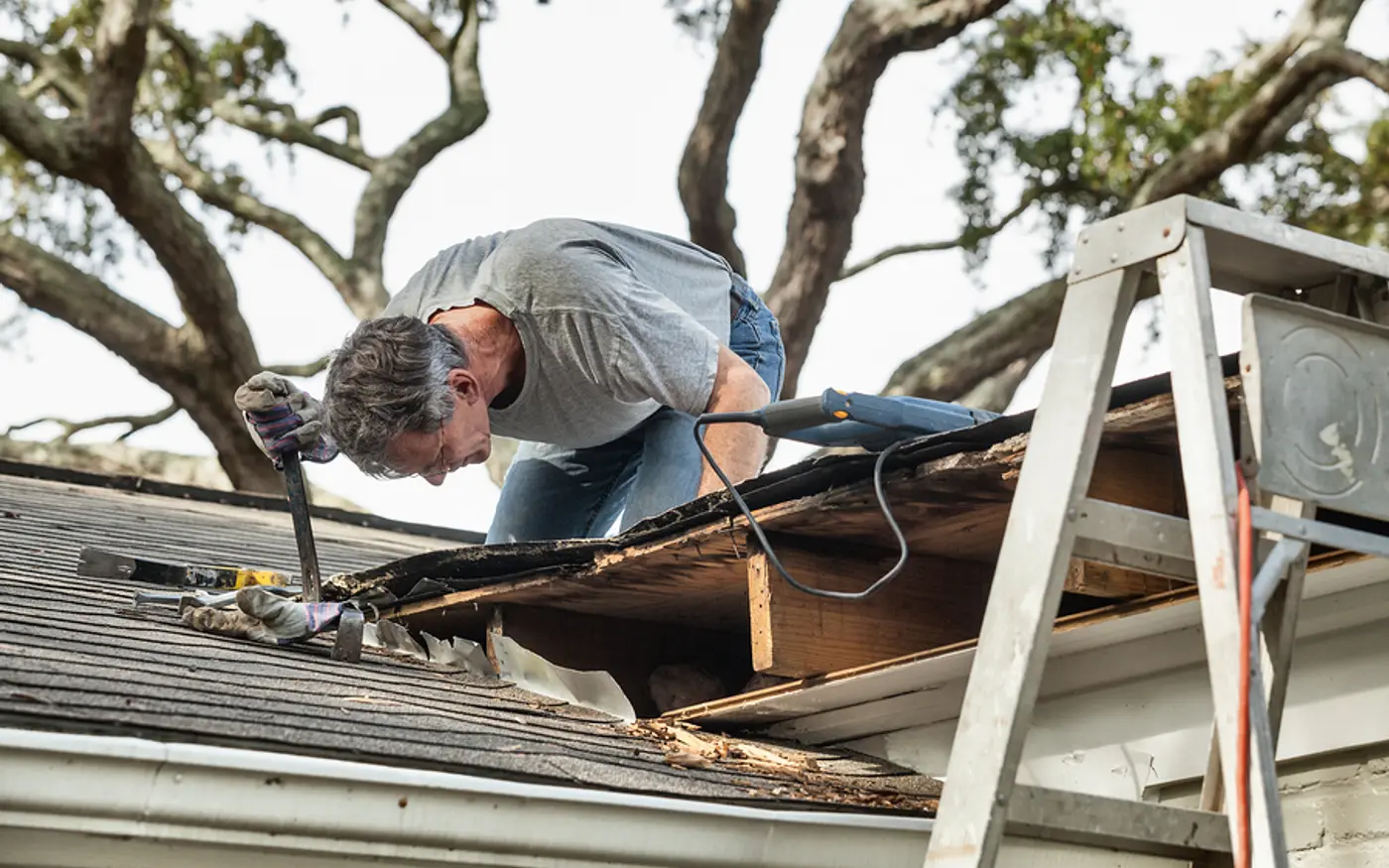
If your roof already has two layers, the residential code doesn't allow a third, so the next roof has to come down to the deck. That's not a bad thing: tear-off is the only way to find and fix the decking problems above.
Wind damage
Older shingles lose their seal and lift in strong wind, and St. Peters has seen plenty of it. Lifted tabs, creased shingles and missing ridge caps are the typical signs. A roof repair can handle scattered wind damage if the rest of the roof is sound.
Ventilation and attic heat
Some older homes have too little intake ventilation at the soffits, which bakes shingles from below and shortens their life. We check intake and exhaust on every replacement and balance them in the new roof.
St. Peters re-roof permits and code
Unlike the City of St. Charles, St. Peters publishes its own Residential Re-Roofing Requirements. According to those requirements, a permit is needed when:
- more than 25% of the roof sheathing needs replacing, or
- the roof covering changes to a different material, such as asphalt shingles to metal.
The requirements also address existing board sheathing whose gaps are too wide. A like-for-like shingle replacement on sound decking generally doesn't need a permit. Because decking condition often isn't known until tear-off, we plan for that possibility in the quote. Confirm your project with the St. Peters Building Department before work starts. Our roof permit guide for St. Charles County compares the rules in St. Peters, St. Charles, Cottleville and the unincorporated county.
| Code item | City of St. Peters | Unincorporated St. Charles County |
|---|---|---|
| Residential code | 2021 IRC (Chapter 504, adopted December 2023) | 2021 St. Charles County Residential Code |
| Ultimate design wind speed | 115 mph | 107 mph |
| Ground snow load | 20 psf | 20 psf |
| Weathering | Severe | Severe |
| Ice barrier underlayment | None required | Not required |
| Drip edge | Required | Required at eaves and rakes |
The 115 mph figure is the one to watch. It means the shingle's wind rating and the nailing pattern need to match the city's standard, so check the product's ASTM D7158 or D3161 class on any quote. Even though ice barrier isn't required, we install it in valleys and around penetrations. If your subdivision has indentures or trustees, check them for roof color or material rules as well.
Storms in St. Peters
According to the National Weather Service, storms on May 26, 2024 brought spotter-estimated 70 mph winds to St. Peters, and the Weather Service reported hail up to 2.75 inches near Saint Charles during the same outbreak. Two months earlier, on March 14, 2024, supercells produced 3 to 3.75 inch hail across St. Charles County. And on July 26, 2022, St. Peters recorded 12.3 inches of rain, an unofficial record for the area, the kind of downpour that finds every weak flashing joint. Our St. Charles County hail history lays out the major storms by date. After a storm, our storm and hail damage service documents what we find with dated photos you can share with your insurer.
In St. Peters, the decking under the shingles decides how the job is permitted.
Roofing services St. Peters homeowners ask for
- Full replacement on 1970s–90s homes. A roof replacement here usually means removing one or two layers, replacing damaged sheathing, and installing new underlayment, drip edge, flashing and ventilation to the city's 115 mph standard.
- Hail-resistant upgrades. Shingles tested to UL 2218 Class 4 resist impact better than standard shingles, though none are hail-proof. Some insurers offer a discount for them.
- Material changes. Metal roofing and stone-coated steel both last longer than asphalt; under St. Peters' requirements, switching materials calls for a permit.
- Checkups. A roof inspection after a storm or before a sale shows what shape the roof is in.
Planning a St. Peters re-roof
- We look before we quote. On the roof and in the attic where we can, we count layers, probe for soft decking and check ventilation, and photograph what we find.
- We flag the permit question early. If the roof looks likely to need more than 25% new sheathing, or you're changing materials, we tell you up front so you can confirm with the Building Department before the job is scheduled.
- We build to the city's standard. That means shingles and nailing matched to the 115 mph design wind speed, drip edge, proper valley and wall flashing, and balanced ventilation.
- We clean up and walk you through it. Debris leaves with us, and we go over the finished roof with you.
Nearby areas we serve
St. Peters borders Harvester, where some parcels are inside St. Peters and others are in unincorporated county, so permit rules depend on the address. Just west is Cottleville, and to the southwest is Weldon Spring. Our office is on South Fifth Street in St. Charles, a short drive east on I-70. Call (636) 242-5111, 8am to 8pm, seven days a week.
Frequently Asked Questions
Do I need a permit to replace my roof in St. Peters?
Sometimes. St. Peters publishes Residential Re-Roofing Requirements, which call for a permit when more than 25% of the roof sheathing needs replacing or when the roof covering changes to a different material. A straight shingle-for-shingle replacement on sound decking generally doesn't need one. Confirm with the St. Peters Building Department before work starts, since only the city can say what applies to your project.
Why is the wind speed higher in St. Peters than in the rest of the county?
St. Peters' adopted code table lists an ultimate design wind speed of 115 mph, while unincorporated St. Charles County uses 107 mph. In practice that means shingle wind ratings and nailing patterns need to match the city's number. Most architectural shingles installed to the manufacturer's high-wind instructions meet it, but it's worth checking the product's ASTM D7158 or D3161 wind class on your quote.
My house is in Spencer Creek. What should I know about its roof?
Spencer Creek's West Village, South Village and Nob Hill sections were built roughly 1977 to 1983, so most homes there are on at least their second roof. Expect to find older decking, possibly two layers of shingles, and ventilation that wasn't designed to modern standards. Because replacing more than 25% of the sheathing triggers a St. Peters permit, decking condition matters when planning the job.
Was St. Peters hit by the May 2024 storms?
Yes. The National Weather Service reported spotter-estimated 70 mph winds in St. Peters on May 26, 2024, and hail up to 2.75 inches fell near Saint Charles during that event. Earlier that spring, on March 14, 2024, supercells dropped 3 to 3.75 inch hail over St. Charles County. If you never had your roof checked after those storms, look for lifted or missing shingles and dented vents.
Do St. Peters HOAs have rules about roof color or material?
Some subdivisions do, through their indentures or trustees, and the rules vary from one neighborhood to the next. Check your subdivision's documents or ask your trustees before choosing a shingle color or switching to metal. If you change to a different roofing material, remember that St. Peters' re-roofing requirements also call for a city permit in that case.
How do I get a roof quote in St. Peters?
Call (636) 242-5111 between 8am and 8pm, any day of the week, or use the quote form on this page. We'll look at the roof, photograph what we find, tell you whether a repair will do, and give you a free written quote that lists materials, flashing, ventilation and how any decking replacement is priced.